You can access the distribution details by navigating to My Print Books(POD) > Distribution
Add a Review
This book ships within India only.
Description
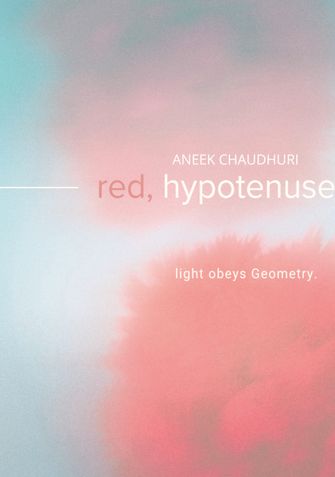
Red, Hypotenuse is a meditation on tension — between emotion and logic, instinct and proof, blood and geometry.
Red is not merely a color here; it is a frequency, a pulse at roughly 620–750 nanometers, the longest visible wavelength the human eye can hold before sight dissolves into infrared silence. It is the first cry of a newborn, the flare of a brake light in rain, the bruise of sunset dissolving behind a city skyline. Red is urgency, warning, devotion, danger — the chromatic embodiment of extremity.
The hypotenuse, by contrast, is restraint. It is the longest side of a right-angled triangle — the quiet, inevitable line that connects what appears separate. In the logic of the Pythagorean theorem, it is destiny measured:
a² + b² = c².
Two perpendicular certainties converge, and the hypotenuse emerges as consequence.
Together, red and hypotenuse create a paradox. One is visceral; the other, rational. One bleeds; the other calculates. Yet both describe intensity. The hypotenuse is the longest stretch within a confined system. Red is the longest wavelength within visible light. Each occupies an edge — the farthest reach before transformation.
In Red, Hypotenuse, geometry becomes emotional architecture. The right angle is conflict; the two shorter sides are opposing forces — love and fear, faith and doubt, art and science. The hypotenuse is the path of transcendence, the diagonal escape that refuses orthodoxy. And red stains that diagonal — a reminder that even in mathematics, there is drama.
This is not merely a study of color or form. It is an exploration of how passion can be measured, how intensity can be mapped, and how the longest line in a contained space often carries the deepest weight.
Because sometimes, the straightest way across is not horizontal or vertical —
it is diagonal,
and it is red.
About the Author
Book Details
ISBN: 9798250347150
Publisher: Sarva Prakash
Number of Pages: 224
Dimensions: 5.82"x8.28"
Interior Pages: B&W
Binding:
Hard Cover (Case Binding)
Availability:
In Stock (Print on Demand)
Ratings & Reviews
Red, Hypotenuse
Review This Book
Write your thoughts about this book.

Currently there are no reviews available for this book.
Be the first one to write a review for the book Red, Hypotenuse.
Other Books in Entertainment

Archana Thakur

Aftab Datta

Mohit Sharma "Trendster", Various Artists