You can access the distribution details by navigating to My Print Books(POD) > Distribution
Add a Review

Foundations of Cloud Computing and Its Applications: An ...
Dr. Ira Nath Dr. Sumit Das Prof. (Dr.) ...
NEW DIGITAL PHYSICS
Dr. Jitendra Gaur, Prof. (Dr.) B. K. Sarkar, ...
ডেটা সাইন্স: সাপ্লাই চেইন ইনপুট সোর্সিং উন্নত করতে ...
S M Nazmuz Sakib
Open Source For You, May 2015
EFY Enterprises Pvt Ltd
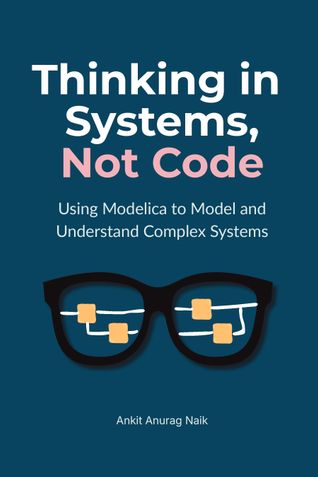
Thinking in Systems, Not Code
Using Modelica to Model and Understand Complex Systems
Ankit Anurag Naik
This book ships within India only.
 Free Shipping
Description
Most people are taught to solve problems by breaking them into steps and writing code.
But complex systems—energy grids, electric vehicles, industrial processes, and organizations—don’t behave like step-by-step programs.
They behave like systems: interconnected, feedback-driven, and emergent.
Thinking in Systems, Not Code teaches you to model reality the way it actually works—not as sequences of instructions, but as structures where behavior emerges from relationships.
Using Modelica and equation-based modeling, you’ll learn to ask:
“How is this system structured?”
instead of
“How do I compute this?”
This shift makes complexity manageable—and models reusable across domains.
What You’ll Learn
Frame problems as systems, not isolated calculations
Choose meaningful system boundaries and levels of abstraction
Model using structure and relationships, not execution order
Apply conservation laws, feedback, and hierarchy across domains
Build models that scale, adapt, and reveal emergent behavior
Use models as tools for reasoning and decision-making—not just simulation
Who This Book Is For
This book is for readers who work with complex technical or socio-technical systems and want a deeper, more rigorous way to reason about them.
You may be:
An engineer working with physical, energy, or cyber-physical systems
A researcher or educator modeling dynamic processes
A systems architect or technical decision-maker evaluating design trade-offs
A practitioner using models, simulations, or quantitative analysis to support decisions
No prior Modelica experience is required.
Familiarity with basic mathematics, equations, or modeling concepts is helpful.
About the Author
Book Details
ISBN: 9789153181774
Publisher: Ankit Anurag Naik
Number of Pages: 160
Dimensions: 6"x9"
Interior Pages: B&W
Binding:
Paperback (Perfect Binding)
Availability:
In Stock (Print on Demand)
Ratings & Reviews
Thinking in Systems, Not Code
Review This Book
Write your thoughts about this book.
Currently there are no reviews available for this book.
Be the first one to write a review for the book Thinking in Systems, Not Code.
Other Books in Engineering

Dr. Ira Nath Dr. Sumit Das Prof. (Dr.) ...

Dr. Jitendra Gaur, Prof. (Dr.) B. K. Sarkar, ...

S M Nazmuz Sakib
EFY Enterprises Pvt Ltd