You can access the distribution details by navigating to My Print Books(POD) > Distribution
Add a Review
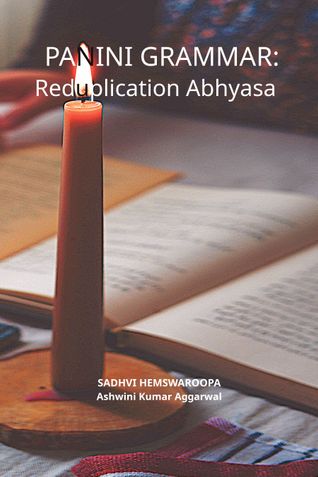
Type:
Print Book
Genre: Education & Language, Reference
Language: English, Sanskrit
Price:
₹240
+ shipping
Description
Reduplication is a broad term, often specialized in linguistics, referring to repeating a word or syllable, sometimes with changes, for emphasis or grammatical function.
• Meaning: Repeating a word or part of a word, often with slight phonetic changes, for grammatical or semantic purposes.
• Examples:
o English: "hocus-pocus," "flip-flop," "teeny-weeny"
o Linguistics: In Greek/Latin verbs, repeating a syllable for the perfect tense (e.g., dari to dedi).
o In Sanskrit Linguistics: In Sanskrit Verbs, repeating a portion of the Root for the Past Perfect Tense. e.g. पच् + लिट् → पच् पच् + णल् → पपाच । He had cooked.
o In Sanskrit Verbs, repeating a portion of the 3rd Conjugation Root for the Present Tense. e.g. हु + लट् → हु हु + ति → जुहोति । He offers.
In the Pāṇinian tradition of Sanskrit grammar, the term abhyāsa अभ्यास refers to the first syllable of a reduplicated radical or root form. Reduplication itself is the morphological process of repeating a part or all of a word's radical element to convey grammatical function or meaning.
How Abhyāsa Works in Reduplication:
The process of reduplication involves specific rules laid out in the text – The Aṣṭādhyāyī of Pāṇini. The abhyāsa often undergoes phonetic modifications (e.g., vowel shortening or consonant elision) that differentiate it from the main root it precedes.
For example, when forming verbal forms for लिट् Past Perfect Tense:
• The root पच् pac (to cook) is doubled. पच् + पच्
• The abhyāsa portion after phonetic modification is प
• The abhyasta portion is प पच्
• The reduplicated Verb becomes पपाच papāca (had cooked).
For example, when forming verbal forms for यङ् Intensive:
• The root गम् gam (to go) is doubled. गम् + गम्
• The abhyāsa portion after phonetic modification is ग
• The abhyasta portion is ग गम्
• The augment नुक् gets inserted
• The final Verb becomes जङ्गम्यते jaṅgamyate (frequently goes).
The rules surrounding the abhyāsa are crucial for generating the correct grammatical forms in Sanskrit, determining aspects like the appropriate augment (e.g., नुक् nuk) or the elision of certain consonants.
About the Authors
Book Details
ISBN: 9789348012760
Publisher: Devotees of Sri Sri Ravi Shankar Ashram
Number of Pages: 84
Dimensions: 6"x9"
Interior Pages: B&W
Binding:
Paperback (Perfect Binding)
Availability:
In Stock (Print on Demand)
Ratings & Reviews
Panini Grammar: Reduplication Abhyasa
Review This Book
Write your thoughts about this book.

Currently there are no reviews available for this book.
Be the first one to write a review for the book Panini Grammar: Reduplication Abhyasa.
Other Books in Education & Language, Reference

G Keerthana Prasanna

Tucareers.com
Vishwanath K N

DR. SURJYOTI S BAGCHI