You can access the distribution details by navigating to My Print Books(POD) > Distribution
Add a Review
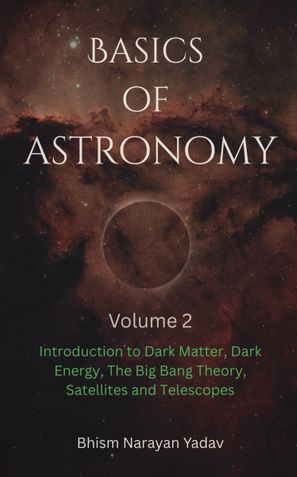
Basics of Astronomy Volume 2
Introduction to Dark Matter, Dark Energy, The Big Bang Theory, Satellites and Telescopes
Bhism Narayan YadavType:
Print Book
Genre: Education & Language, Science & Technology
Language: English
Price:
₹599
+ shipping
Description
The Big Bang Theory remains one of the most profound scientific achievements in human history. It provides a compelling explanation for the birth and evolution of the universe, supported by extensive observational evidence.
The quest to measure cosmic distances is a fundamental aspect of modern astrophysics and cosmology. From nearby stars to the farthest galaxies, each measurement refines our understanding of the universe’s structure, expansion, and evolution.
Despite decades of research, dark matter and dark energy remain some of the most profound mysteries in cosmology. Their existence is supported by strong indirect evidence, but their fundamental nature remains unknown. With new telescopes, experiments, and theoretical breakthroughs, scientists hope to unlock their secrets in the coming decades. Understanding these invisible forces could revolutionize our knowledge of the universe and lead to groundbreaking discoveries in physics, cosmology, and beyond.
This book contains the following topics for beginners:
1. Types of Galaxies
2. The Structure of the Milky Way
3. Cosmic Distance Measurement Techniques
4. Dark Matter and Dark Energy
5. The Big Bang Theory
6. Expansion of the Universe
7. Cosmic Microwave Background Radiation
8. Basics of Radiation and Spectroscopy
9. Gravitational Physics
10. Exoplanet Detection and Analysis
11. High-Energy Astrophysics (Pulsars, Quasars, Gamma Ray Bursts)
12. Conditions for Life in the Universe
13. Telescopes Optical, Radio, Infrared, X-Ray
14. Space-Based Observatories (Hubble, James Webb)
15. Data Analysis in Astronomy
16. Key Historical Missions (Apollo, Voyager, Mars Rovers)
17. Future Space Exploration Goals (Moon Bases, Mars Colonization)
18. Spacecraft Design and Technology
19. Satellites Types and Functions
20. Space Debris and Sustainability
About the Author
Book Details
Number of Pages: 290
Dimensions: 5"x8"
Interior Pages: B&W
Binding:
Paperback (Perfect Binding)
Availability:
In Stock (Print on Demand)
Ratings & Reviews
Basics of Astronomy Volume 2
Review This Book
Write your thoughts about this book.

Currently there are no reviews available for this book.
Be the first one to write a review for the book Basics of Astronomy Volume 2.
Other Books in Education & Language, Science & Technology

spc Academic

Jobin Thomas

M.K. Setia

doddi praveen