You can access the distribution details by navigating to My Print Books(POD) > Distribution
Add a Review
Type:
Print Book
Genre: Business & Economics, Information Technology
Language: English
Price:
₹212
+ shipping
Description
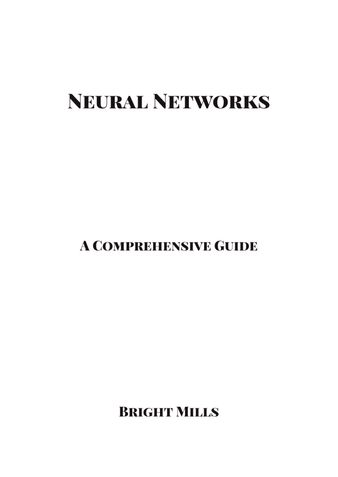
This book, "Neural Networks: A Comprehensive Guide," provides a detailed exploration of neural networks, their history, types, architecture, and advanced concepts. It is designed for beginners and experienced readers who want to deepen their understanding of neural networks and their applications. Starting from foundational concepts, the book gradually explores complex architectures and real-world applications, ensuring a solid understanding of neural networks in modern artificial intelligence. Neural networks are inspired by the way, the human brain learns, adapts, and makes sense of the world. At their core, they are systems of interconnected “neurons” that process information, learn from experience, and improve over time. Rather than following rigid, pre-programmed rules, neural networks discover patterns in data often patterns too complex for traditional programming to capture. A neural network works by passing data through multiple layers. The input layer receives raw information, hidden layers transform it by assigning different levels of importance, and the output layer produces a result such as a prediction, classification, or decision. Through a learning process called training, the network compares its outputs to correct answers, measures errors, and adjusts its internal connections to perform better next time. Over many iterations, this process allows the model to “learn” from examples. What makes neural networks especially powerful is their ability to handle unstructured data. They excel at tasks involving images, speech, text, and complex signals powering applications like facial recognition, voice assistants, language translation, medical diagnosis, and fraud detection. As networks grow deeper and more sophisticated, they can recognize subtle relationships and abstractions that resemble human-like understanding. Despite their strengths, neural networks are not magic. They require large amounts of data, careful design, and significant computing power. They can also be difficult to interpret, often functioning as “black boxes.” Still, their impact is undeniable. Neural networks form the foundation of modern artificial intelligence, enabling machines not just to follow instructions, but also to learn, adapt, and continuously improve in a rapidly changing world.
About the Author
Book Details
Publisher: Self-Publish
Number of Pages: 79
Dimensions: 8.27"x11.69"
Interior Pages: B&W
Binding:
Paperback (Perfect Binding)
Availability:
In Stock (Print on Demand)
Ratings & Reviews
Neural Networks
Review This Book
Write your thoughts about this book.

Currently there are no reviews available for this book.
Be the first one to write a review for the book Neural Networks.
Other Books in Business & Economics, Information Technology

Raju Sreenivasan

Prithvi Madhukar

Sujai G Pillai, A I

S.Sunder Rajan