Description
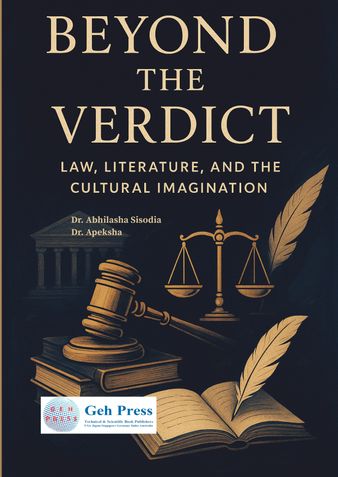
This chapter examines the fundamental intersections between legal discourse and literary
expression, exploring how law functions not merely as a regulatory mechanism but as a
complex narrative and performative practice that shapes social reality through textual
interpretation and dramatic enactment. Through comprehensive analysis of legal texts as
narrative forms, courtroom theatricality, and literary representations of justice, we investigate
how language, rhetoric, and symbolic performance constitute the very foundation of legal
meaning-making and institutional authority. The chapter traces the evolution of law and
literature studies from classical foundations through contemporary critical theory,
demonstrating how literary analysis illuminates the cultural dimensions of legal authority,
judicial decision-making, and the ongoing construction of justice in democratic societies. By
examining the works of Shakespeare, Dickens, and Kafka alongside contemporary legal theory,
we reveal how legal institutions operate through sophisticated systems of narrative
construction, performative ritual, and symbolic communication that transcend purely rational
or procedural justification.
Dr. Abhilasha Sisodia
Dr. Abhilasha Sisodia is currently working as an Associate Professor and Coordinator
in school of Law of KCC Institute of Legal and Higher Education, she is having
teaching experience in this field over more than 12 incredible years. Her academic
journey began at the prestigious Banaras Hindu University from where she has
completed her Intermediate, followed by LLB from Jiwaji University, Gwalior, where
she was honored as Gold Medalist for her outstanding academic performance. She
further pursued her Masters from Pune University and Ph.D. from Galgotias
University. As a speaker and resource person, she has delivered keynote addresses
and participated in capacity-building workshops across institutions. As an educator,
she believes in making learning creative, lasting, and impressive. She has
successfully published over 25 research articles and review papers in reputed
national and international journals, including those indexed in UGC-CARE and
SCOPUS, as well as contributed chapters to peer-reviewed edited volumes.
Dr. Apeksha
Dr. Apeksha, graduated from Banaras Hindu University (BHU), Varanasi and doctoral
from Malaviya National Institute of Technology (MNIT), Jaipur, is presently working
as an Associate Professor & Research Coordinator in the Department of Languages,
Noida Institute of Engineering & Technology (NIET), Greater Noida. She brings over
13 years of academic and research experience to the field of English literature and
language studies. Her teaching interests span English literature, gender studies, and
communication, while her interdisciplinary research explores themes of identity,
digital transformation, and intercultural communication. She has been honoured with
the INSC Young Researcher Award and the Research Excellency Award for her
outstanding contributions to research and innovation. Her academic interests span a
wide range of areas including British Drama, Theatre (with a focus on comparative
analysis), Gender Studies, Postcolonial Literatures, Literary and Cultural Theory,
Indian Literature in English, and the development of core competencies in English
language instruction. She is the author of the critically acclaimed book John Whiting:
The Agony of the Absurd, which offers an in-depth analysis of John Whiting’s work as
an absurdist playwright. The book is cited in Google Scholar, World Cat, and
Academia.edu, and is recognized for its incisive commentary on Whiting’s literary
craft. She has successfully published over 30 research articles and review papers in
reputed national and international journals, including those indexed in UGC-CARE and
SCOPUS, as well as contributed chapters to peer-reviewed edited volumes. As a
speaker and resource person, she has delivered keynote addresses and participated
in capacity-building workshops across institutions. She also holds memberships in
prestigious academic bodies and serves on the editorial boards of international
journals