You can access the distribution details by navigating to My Print Books(POD) > Distribution
Add a Review
This book ships within India only.
Description
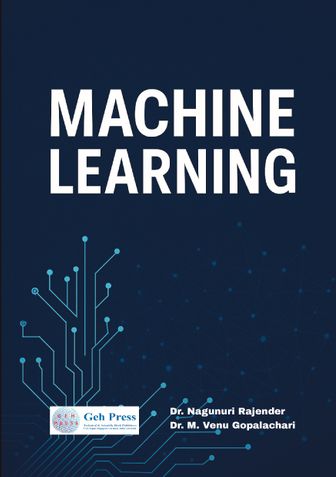
Machine learning stands at the intersection of computer science, statistics, and
cognitive science, representing one of the most transformative technological
paradigms of our era. This chapter establishes the foundational concepts that
underpin the entire field of machine learning, providing both theoretical
frameworks and practical perspectives. We begin by examining the
fundamental types of machine learning and their biological inspirations,
exploring how computational systems can be designed to learn from experience
much as humans do. The chapter progresses through the essential components
of designing effective learning systems, highlighting key perspectives that
shape modern approaches to machine learning problems. We then explore
concept learning as a fundamental cognitive process, examining how search
strategies operate within hypothesis spaces. The notion of version spaces and
the candidate elimination algorithm provide elegant frameworks for
understanding how consistent hypotheses evolve during the learning process.
Finally, we examine linear discriminants—specifically the perceptron and
linear regression models—which serve as building blocks for many more
complex algorithms. By establishing these foundations, readers will develop
the conceptual toolkit necessary to understand more advanced machine
learning techniques explored in subsequent chapters.
About the Authors
Book Details
ISBN: 9789367172049
Publisher: GEH Press
Number of Pages: 149
Dimensions: A5
Interior Pages: B&W
Binding:
Paperback (Perfect Binding)
Availability:
In Stock (Print on Demand)
Ratings & Reviews
Machine Learning
Review This Book
Write your thoughts about this book.

Currently there are no reviews available for this book.
Be the first one to write a review for the book Machine Learning.
Other Books in Education & Language

Reza
![Brilliant, Bright & Beautiful [English Language (English for all classes)]](https://simg.pothi.com/oMCR9A-nzUEk9Cxx-aN7PG4PBx1G-8SgDw6Sd5-WXEw/rs:fit/w:130/h:175/el:1/g:sm/cb:rev-3/bG9jYWw6Ly8vaW1h/Z2VzL3Byb2R1Y3Rz/LzIwMjUvMDYvU0tV/MzA3ODAvSW1hZ2Vf/MC5qcGc.jpg)
Prof. Er. BL Hans Baghel

AMAN YADAV, Gaurav Verma
Editor : Rajiv Mani