Description
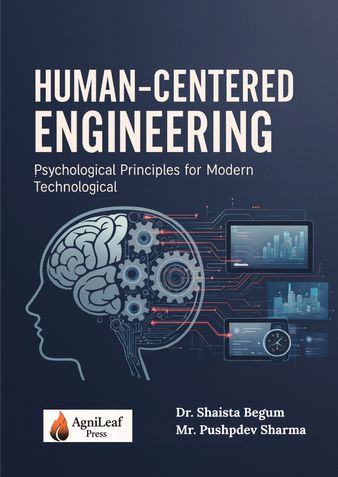
This chapter establishes the foundational principles of human-centered
engineering by exploring the integration of human factors, cognitive psychology,
and technological design. It examines the evolution of human-technology
interaction, the significance of systems thinking in engineering contexts, and the
critical role of behavioral sciences in creating effective technological solutions.
The chapter emphasizes the shift from technology-driven design to user-focused
methodologies, highlighting principles of usability, accessibility, and sociotechnical integration. Through conceptual frameworks and practical insights,
readers will understand how human capabilities and limitations shape engineering
decisions, particularly within India's diverse technological landscape.
Dr. Shaista Begum
Assistant Professor,
IIMT University, Meerut, Department of Psychology
Introduction: Dr. Shaista Begum currently serves as an Assistant Professor in the Department of Psychology at IIMT University, Meerut.
Educational Background: Dr. Shaista Begum completed her undergraduate education at Chaudhary Charan Singh University. She then obtained a Master's degree in Psychology and Education from Chaudhary Charan Singh University. She then obtained a B.Ed. degree from Chaudhary Charan Singh University. She then obtained a PhD in Psychology from Glocal University, Saharanpur.
Professional Experience: Dr. Shaista Begum begen her teaching career as a teacher at Ismail National mahila PG College, Meerut. She then served as an Assistant Professor at Monad University, Hapur. She currently holds the position of Assistant Professor at IIMT University, Meerut. She has 13 years of experience in the field of education. She has conducted research on several important topics and presented her papers at various national and international conferences. She has also been honored by various organizations in the field of education.
Publications and Research: Many of Dr. Shaista Begum's research papers have been published in prestigious national, international, and Scopus journals.
Dr. Shaista Begum has carved a significant for herself in the field of psychology through her research and teaching. Her aim is to raise awareness among psychology students about educational issues and inspire them to actively participate in educational reform. Her dedication and commitment make her an ideal teacher in the field of psychology.
Mr. Pushpdev Sharma
Assistant Professor,
IIMT Engineering College (Affiliated to Dr. A.P.J. Abdul Kalam Technical University), Meerut
Mr. Pushpdev Sharma is an Assistant Professor at IIMT Engineering College, Meerut (affiliated to AKTU). He holds a Master’s degree from Dr. A.P.J. Abdul Kalam Technical University, Lucknow, and a Bachelor’s degree from IIMT University, Meerut. His academic journey reflects a strong foundation in modern computing, intelligent systems, and emerging technologies.
With professional experience as a Software Developer in a multinational company and academic roles at renowned institutions including Monad University, he brings a blend of industry exposure and academic depth to the classroom. His expertise spans programming, Internet of Things (IoT), Artificial Intelligence, Machine Learning, robotics, and cloud-based automation.
Mr. Sharma has contributed to several advanced, high-impact projects such as:
- Autonomous Drone Navigation System using AI, LiDAR, and IoT
- Industrial Smart Factory Automation integrating IIoT, Edge AI, and Cloud Computing
- AI-Based Smart City Surveillance Grid with facial recognition and behavior analysis
- Self-Driving Car Prototype Simulation using deep learning and sensor fusion
- Deep Learning-Based Medical Imaging System for disease detection
- Blockchain-Integrated Secure Voting System
- Disaster Response Autonomous Rover for rescue operations
- AI-Driven Traffic Prediction & Optimization System
- Smart Energy Grid Optimization Platform using IoT and edge analytics
His work reflects a commitment to innovation, research, and real-world applications of cutting-edge technologies. Mr. Sharma’s vision is to inspire engineering students to think creatively, embrace new technologies, and develop solutions that contribute to a smarter and more sustainable future.