You can access the distribution details by navigating to My Print Books(POD) > Distribution
Add a Review
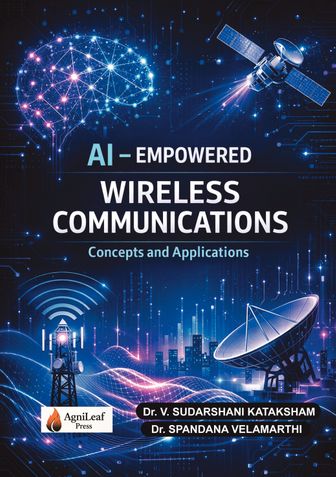
AI – EMPOWERED WIRELESS COMMUNICATIONS
CONCEPTS AND APPLICATIONS
Dr. V. Sudarshani Kataksham, Dr. Spandana Velamarthi
This book ships within India only.
Description
The rapid advancement of wireless communication technologies, combined with the explosive growth of data traffic and connected devices, has significantly increased the complexity of modern communication systems. Traditional model-based design and optimization techniques, while mathematically rigorous and well-established, are increasingly challenged by highly dynamic environments, heterogeneous network architectures, and stringent performance requirements such as ultra-low latency, massive connectivity, and high spectral efficiency. In this context, artificial intelligence (AI) has emerged as a transformative paradigm capable of enabling intelligent, adaptive, and self-optimizing wireless systems.
The structured and comprehensive exploration of the fundamental principles of wireless communication and artificial intelligence, and demonstrates how these two domains can be effectively integrated to address real-world communication challenges. The book begins by establishing a strong foundation in the basics of wireless communication, including electromagnetic spectrum usage, signal propagation mechanisms, noise and interference effects, fading phenomena, multiple access strategies, network architectures, and key performance metrics. These concepts form the technical backbone necessary for understanding intelligent communication system design.
About the Authors
Book Details
ISBN: 9789347142635
Publisher: AgniLeaf
Number of Pages: 149
Dimensions: 6.93"x9.84"
Interior Pages: B&W
Binding:
Paperback (Perfect Binding)
Availability:
In Stock (Print on Demand)
Ratings & Reviews
AI – EMPOWERED WIRELESS COMMUNICATIONS
Review This Book
Write your thoughts about this book.

Currently there are no reviews available for this book.
Be the first one to write a review for the book AI – EMPOWERED WIRELESS COMMUNICATIONS.
Other Books in Computers & Internet

Ravi Mohan Srivastava

Biswanath Parida

Syed Mohtasim Ali

Prithwis Mukerjee