You can access the distribution details by navigating to My pre-printed books > Distribution
Add a Review
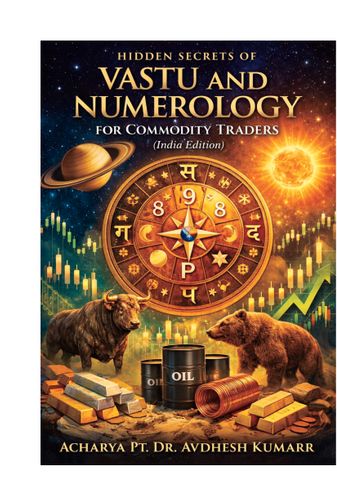
The Trader’s Hidden Compass (eBook)
Ancient Wisdom of Vastu and Numerology Applied to Modern Commodity Markets
Type:
e-book
Genre: Self-Improvement, Religion & Spirituality
Language: English
Price:
₹180
(Immediate Access on Full Payment)
Description
Acharya Pt. Dr. Avdhesh Kumarr’s *The Trader’s Hidden Compass* is a distinctive work that bridges ancient Indian wisdom with modern commodity trading. It begins with a dedication to ancestors, mentors, and seekers, emphasizing that trading is not only about profit but also about balance, discipline, and awareness. The preface sets the tone: commodity markets in India—Gold, Silver, Crude Oil, Natural Gas, Copper, Zinc, Aluminium—are shaped not just by supply and demand but also by psychology and unseen forces. The book argues that Vastu Shastra and Numerology, while not substitutes for rational analysis, can enrich a trader’s perspective by revealing cycles, tendencies, and symbolic patterns.
The early chapters introduce commodities, their categories (precious metals, energy, industrial metals), and the evolution of trading in India from mandis to electronic exchanges like MCX. Detailed explanations of futures contracts, margin trading, and price discovery provide clarity for beginners. The narrative then shifts to psychology: fear and greed as dominant emotions, herd behavior, and the importance of discipline. Traders are urged to cultivate emotional control to survive volatility.
Numerology is introduced as a tool for self‑awareness. Readers learn to calculate their “Trader Number,” explore lucky numbers, and observe numerical cycles (9‑day, 18‑day, 27‑day). Each commodity is examined through numerological lenses—Gold as a safe haven tied to cycles of fear, Silver as dual and volatile, Crude Oil as geopolitically sensitive, Natural Gas as erratic, and industrial metals as mirrors of economic expansion. These insights are illustrated with case studies, showing how numbers and vibrations align with market behavior.
Vastu principles are woven into trading practice: the orientation of a desk, the energy of a room, and the discipline of meditation and journaling. Trading is framed as both a mental and spiritual discipline, requiring patience, humility, and reflection. Later chapters expand into planetary cycles, especially Saturn’s influence, and global economics—interest rates, currency movements, industrial demand. Case studies of Gold in the 1970s, Oil in the 2000s, and Silver in the 2010s highlight how the dollar’s strength or weakness shapes commodity prices.
Crowd psychology and risk management are explored in depth. Historical events like the Oil Shock of 1973 and the 2008 boom‑bust cycle illustrate collective emotions. Risk management rules—never risk more than a small percentage, always use stop‑loss, avoid excessive leverage—are reinforced with examples like the Turtle Traders experiment. Building a personal trading system is presented as essential, combining technical indicators, fundamentals, price action, and timing tools, with discipline as the cornerstone.
The book looks forward to the future of commodity markets: electric vehicles, renewable energy, infrastructure expansion, ESG imperatives, and technological disruption. Traders are urged to adapt continuously to sustainability and geopolitical shifts. Lessons from great traders emphasize patience, discipline, emotional control, and continuous learning, integrated into a practical framework for modern trading.
The final conclusion, “The Hidden Balance,” encapsulates the book’s philosophy: successful trading requires integration of rational analysis, psychological discipline, numerological awareness, and spiritual harmony. It is a holistic guide that elevates trading from mere speculation to a path of mastery and self‑awareness. By blending ancient wisdom with modern practice, Kumarr offers traders not superstition but a compass—hidden yet powerful—for navigating the dynamic world of commodities.
About the Author
Book Details
Publisher: Acharya Pt. Dr AVDHESH KUMARR
Number of Pages: 107
Availability:
Available for Download (e-book)
Ratings & Reviews
The Trader’s Hidden Compass
Review This Book
Write your thoughts about this book.

Currently there are no reviews available for this book.
Be the first one to write a review for the book The Trader’s Hidden Compass.
Other Books in Self-Improvement, Religion & Spirituality

Rajlaxmi labana


Sidhant Sharma

Dada Bhagwan