You can access the distribution details by navigating to My pre-printed books > Distribution
Add a Review
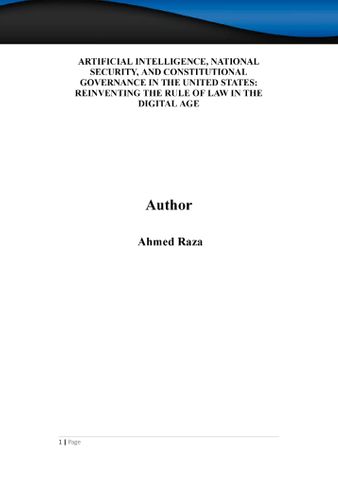
Artificial Intelligence, National security, and. Constitutional Governance in the United States reinventing the rule of law in the Digital age (eBook)
Artificial Intelligence, National security, and. Constitutional Governance in the United States reinventing the rule of law in the Digital age
Type:
e-book
Genre: Law, Science & Technology
Language: English
Price:
₹325
(Immediate Access on Full Payment)
Description
Artificial intelligence has emerged as one of the most consequential
forces shaping legal, social, and institutional life in the twenty-first
century. Its impact extends across both public and private
spheres—transforming the administration of justice, the structure of
markets, the protection of privacy, and the expression of democratic
values. The rapid integration of algorithmic technologies into
everyday decision-making presents a dual challenge for constitutional
law: how to ensure accountability and fairness while enabling
innovation and technological growth.
This work examines the intersection of artificial intelligence and
constitutional governance through that dual lens—supervision and
facilitation. It argues that the constitutional framework of the United
States must evolve not simply to restrain the misuse of technology,
but also to guide and support its lawful and beneficial deployment.
Artificial intelligence should be governed by legal principles that
uphold transparency, equality, and human dignity, yet it should also
be fostered through an enabling legal environment that encourages
research, innovation, and responsible institutional adoption.
The analysis proceeds from the understanding that constitutional law
is not a static instrument of control, but a dynamic framework for
governance. Doctrines such as due process, equal protection, freedom
of expression, and separation of powers provide the normative
structure through which the use of artificial intelligence can be
supervised, without impeding its potential to enhance human welfare
and institutional efficiency. By refining these doctrines and extending
them to algorithmic contexts, the law can preserve its foundational
commitments while adapting to new technological realities.
The concept of Algorithmic Constitutionalism, developed in this
work, reflects that balance. It envisions a constitutional order in
which artificial intelligence operates under legal safeguards that
prevent arbitrariness and bias, while simultaneously benefiting from a
policy framework that incentivizes normative innovation. This
approach seeks harmony between regulation and progress—ensuring
that constitutional amendments, legislative measures, and
institutional practices together promote a culture of lawful
technological advancement.
About the Author
Book Details
ISBN: 9789367172186
Publisher: Geh Press
Number of Pages: 162
Availability:
Available for Download (e-book)
Ratings & Reviews
Artificial Intelligence, National security, and. Constitutional Governance in the United States reinventing the rule of law in the Digital age
Review This Book
Write your thoughts about this book.

Currently there are no reviews available for this book.
Be the first one to write a review for the book Artificial Intelligence, National security, and. Constitutional Governance in the United States reinventing the rule of law in the Digital age.
Other Books in Law, Science & Technology
Nitika Sharma

ER. ARIF KHAN

Swapnonil Banerjee, PhD