You can access the distribution details by navigating to My pre-printed books > Distribution
Add a Review
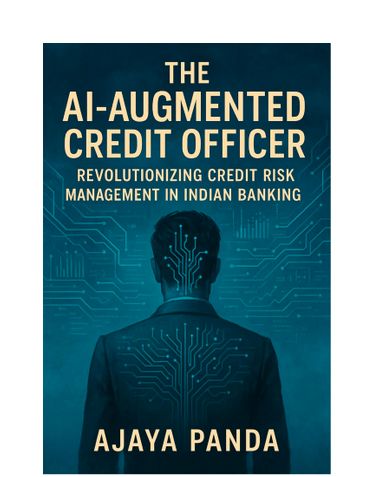
The AI-Augmented Credit Officer Revolutionizing Credit Risk Management in Indian Banking (eBook)
The advent of Artificial Intelligence (AI) and Machine Learning (ML) in Indian Banking
Type:
e-book
Genre: Business & Economics
Language: English
Price:
₹299
(Immediate Access on Full Payment)
Description
The Indian banking sector stands at a critical juncture, transitioning from a traditional, manual-intensive credit appraisal system to a dynamic, technology-driven paradigm. For decades, the manual process, while rooted in the prudent principles of risk assessment, has been fraught with operational inefficiencies, vulnerabilities to fraud, and inherent human biases. These systemic weaknesses have been a significant contributor to the high levels of Non-Performing Assets (NPAs) that have historically plagued the industry, creating a vicious cycle of risk aversion and financial exclusion.
The advent of Artificial Intelligence (AI) and Machine Learning (ML) presents a transformative opportunity to break this cycle. This report provides a comprehensive analysis of the integration of AI into the role of a credit officer in an Indian bank. It begins by deconstructing the traditional credit appraisal workflow, highlighting its foundational principles and systemic challenges, including the "thin-file" conundrum that excludes a vast portion of the population from formal credit. The analysis then details how AI intervenes across the entire credit lifecycle—from automated data ingestion and intelligent underwriting to proactive portfolio monitoring and optimized collections.
A central feature of this report is a detailed use case focusing on AI-powered underwriting for India's Micro, Small, and Medium Enterprises (MSME) sector. This demonstrates how AI, powered by the unique digital public infrastructure of the India Stack, can accurately assess "credit-invisible" businesses by leveraging alternative data sources like GST returns and UPI transactions. This not only enhances financial inclusion but also unlocks a significant, underserved market.
The report delves into the technical and ethical complexities of this transition. It examines the trade-offs between the predictive accuracy of various ML models and the regulatory demand for transparency, underscoring the critical importance of Explainable AI (XAI). Furthermore, it addresses the profound challenge of algorithmic bias, exploring its unique manifestations in the Indian social context and framing it as a critical business risk that requires a nuanced, context-aware governance framework.
Navigating the evolving regulatory landscape, particularly the proactive stance of the Reserve Bank of India (RBI) with its upcoming FREE-AI framework and the landmark Digital Personal Data Protection (DPDP) Act, 2023, is a key theme. The report outlines a compliance blueprint for banks to embed ethical and legal principles into their AI systems by design.
Finally, the report looks to the future, envisioning a credit ecosystem defined by hyper-personalization, where financial products are tailored to a "segment-of-one," and dynamic, AI-driven portfolio management. This transformation redefines the credit officer's role from a manual processor to a strategic, data-savvy analyst. The analysis concludes that for Indian banks, embracing AI in credit management is not merely a technological upgrade but a strategic imperative for achieving sustainable profitability, robust risk management, and inclusive economic growth.
About the Author
Book Details
Publisher: self
Number of Pages: 34
Availability:
Available for Download (e-book)
Ratings & Reviews
The AI-Augmented Credit Officer Revolutionizing Credit Risk Management in Indian Banking
Review This Book
Write your thoughts about this book.

Currently there are no reviews available for this book.
Be the first one to write a review for the book The AI-Augmented Credit Officer Revolutionizing Credit Risk Management in Indian Banking.
Other Books in Business & Economics

Aquilastrat


Pramod More

Snehal Singh, Divya LV Jegasundaram