You can access the distribution details by navigating to My pre-printed books > Distribution
Description
Natural fiber reinforced composites have gained significant attention in modern engineering applications. These materials offer several advantages such as low density, high strength-to-weight ratio, and good resistance to corrosion. The objective of this study is to investigate the structural characteristics of newly explored Pandanus fiber (PDF) and Coconut Root Fiber (CRF) reinforced composites with epoxy matrix containing Al₂O₃ nanoparticles. Pandanus fiber was obtained from the stem of the screw pine plant through a manual water-retting process, whereas coconut root fiber was extracted from the root portion of coconut clusters. Composite laminates were produced using the compression molding technique by varying the fiber length and weight percentage. Specimens containing nanoparticles (NPDF and NCRF) were compared with composites without nanoparticles (PDF and CRF). Mechanical properties such as tensile strength, compressive strength, impact energy, hardness, and natural frequency were evaluated and analyzed. The experimental results indicate that the incorporation of Al₂O₃ nanoparticles enhances the overall strength and performance of the composite panels. Among the two natural fibers, Pandanus fiber exhibited superior mechanical performance compared with coconut root fiber. Due to their low cost, recyclability, and biodegradability, natural fiber composites are increasingly attracting the interest of industries for sustainable material development.
About the Author
Book Details
ISBN: 9789347142130
Publisher: AgniLeaf
Number of Pages: 22
Availability:
Available for Download (e-book)
Ratings & Reviews
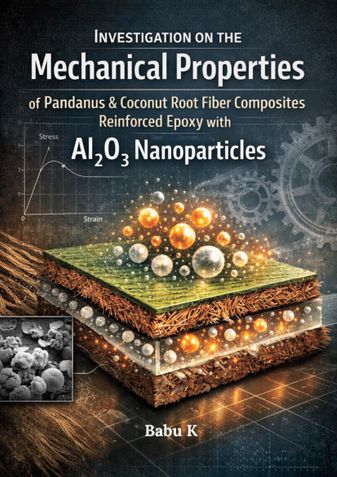
Investigation on the Mechanical Properties of Pandanus & Coconut root fiber Composites Reinforced Epoxy with Al₂O₃ Nano particles
Review This Book
Write your thoughts about this book.

Currently there are no reviews available for this book.
Be the first one to write a review for the book Investigation on the Mechanical Properties of Pandanus & Coconut root fiber Composites Reinforced Epoxy with Al₂O₃ Nano particles.
Other Books in Education & Language

Aryan Sonsale

Anurag Mathur

Dr Sanjay Kumar, Dr. Anita Singh
Anjana D. Prajapati, Lalji S. Chaudhary