You can access the distribution details by navigating to My pre-printed books > Distribution
Add a Review
Type:
e-book
Genre: Business & Economics, Information Technology
Language: English
Price:
₹80
(Immediate Access on Full Payment)
Description
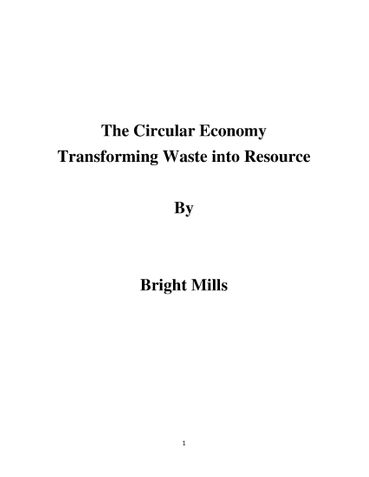
The concept of a circular economy represents a shift from the traditional linear economy, where products are made, used, and discarded, to a system that focuses on minimizing waste and pollution while maximizing the use of resources. This book provides a comprehensive overview of the core principles, strategies, and practices of the circular economy, emphasizing how businesses, governments, and individuals can contribute to a sustainable future. Through innovative design, product life extension, and recycling, the circular economy offers pathways to regenerate natural systems, reduce dependency on finite resources, and promote a more sustainable, regenerative way of living. Exploring diverse applications such as fashion, construction, cities, and plastics, this book highlights how the circular economy can be integrated into various industries and sectors. It examines how waste can be transformed into valuable resources, the role of policy and regulation, and how sustainable consumption practices can lead to long-term environmental and economic benefits. Whether you are an entrepreneur, policymaker, or consumer, this book provides actionable insights for engaging with the circular economy to drive positive change and build a sustainable future. The circular economy is a transformative approach to production and consumption that challenges the traditional “take-make-dispose” model. Instead of treating resources as finite and disposable, it emphasizes designing systems where materials, products, and energy are continuously reused, refurbished, or recycled. This model not only reduces waste but also encourages innovation in product design, supply chain management, and business strategy.
At its core, the circular economy is about creating value from longevity. Products are designed to last longer, be easier to repair, and eventually be repurposed or recycled. Industries rethink material flows, shifting from single-use resources to renewable, regenerative inputs. For example, electronics are redesigned for modular repair, packaging is made biodegradable or fully recyclable, and industrial by-products are repurposed as raw materials for other sectors. The benefits of a circular economy extend beyond environmental sustainability. Businesses can achieve cost savings by reducing material consumption and waste disposal, while also opening new revenue streams through product-as-a-service models, remanufacturing, or secondary markets. Consumers gain access to durable, repairable, and often more affordable goods. On a broader scale, circular systems reduce pressure on natural resources, curb carbon emissions, and foster resilient local economies. Transitioning to a circular economy requires collaboration across governments, businesses, and communities. Policy frameworks, technological innovation, and consumer awareness all play a role in shifting mind-sets from short-term convenience to long-term sustainability. Ultimately, the circular economy represents a shift in how society defines growth and progress moving away from endless extraction toward a system where economic activity works in harmony with the planet’s ecological limits. It is an approach that sees waste not as inevitable, but as a resource waiting to be tapped, creating a regenerative cycle of production, use, and renewal.
About the Author
Book Details
Publisher: Self-Publish
Number of Pages: 117
Availability:
Available for Download (e-book)
Ratings & Reviews
The Circular Economy
Review This Book
Write your thoughts about this book.

Currently there are no reviews available for this book.
Be the first one to write a review for the book The Circular Economy.
Other Books in Business & Economics, Information Technology

Neeraj Kaushik
Vive Odili
Jayant Deshmukh

Dr. Ritu J Gaurav