You can access the distribution details by navigating to My pre-printed books > Distribution
Add a Review
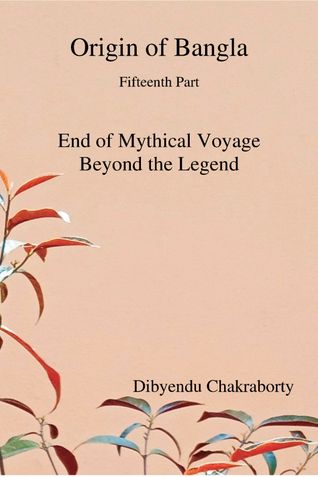
Origin of Bangla Fifteenth Part End of Mythical Voyage Beyond the Legend (eBook)
বাংলার উৎপত্তি পঞ্চদশ পর্ব স্বপ্নের সফরের সমাপ্তি কিংবদন্তী পার হয়ে
Type:
e-book
Genre: Literature & Fiction
Language: English
Price:
₹300
(Immediate Access on Full Payment)
Description
Whatever begins must end, that is the law of the world. It was predetermined that Naru's cerebral journey would end when it began. Even though the end of any journey is predetermined, it does not always reach the desired destination. In order to complete his main journey, Naru was able to ignore the temptation to embark on many interesting new journeys along the way. Whether the entire journey was completed or not, only time will tell, but it is undeniable that the mythical part of his cerebral journey had come to an end.
When scholars who are well-informed about India want to talk about something important about the Indian subcontinent, they try to make connections from the Ramayan and the Mahabharat to that important topic. The main reason for the attempt to establish such a connection is the extensive geographical descriptions given in the Ramayan and the Mahabharat, which cannot be denied in any way. The Mahabharat is used more often than the Ramayan in such efforts because it is a more recent account. Whether the broader human society agrees or not, or the speaker himself may have doubts, the importance of the Mahabharat in shaping the contours of India's past cannot be denied.
There are two main aspects in prehistoric Indian literature that are difficult to accept, but by no means can they be completely ignored. One of them is the theory of the creation of the world, and the other is an account of various events that took place in India at some forgotten time. Those accounts of events from a forgotten time are called 'Itihas'. Mainly, those accounts are given in the Ramayan and the Mahabharat, now known as epics. To date, it has not been possible to find any factual evidence to support those events or any evidence that can logically relate them to known reality. Similarly, it has not been possible to establish any specific connection of present-day India with the references provided in the Mahabharat, other than the similarity of various identities, especially place names and lineages. Logically, any such connection can be dismissed as having arisen later in Indian society as a result of following the so-called fictional story of the Mahabharat. There is an unresolved period between the time of the Mahabharat and the most distant past of authentic history in the present day. Current authentic history suggests that geographically, the history of the Gangetic Plain cannot be more than five thousand years old, because in its past, there was no habitable land there. It took another couple of thousand years for the Bengal Basin region to become habitable, meaning that a large human society was not possible in the Bengal Basin until three to four thousand years before the present.
The structure that the current world follows to record various details of the present is called history in English. There is no real synonym for the word 'history' in Sanskrit or Bengali. According to that tradition, the people of India did not record the daily events, at least not at the present stage of human history. European scholars, as well as scholars of the Bengali Renaissance, were convinced that Bengal had no history. Bright scholars of the Bengali Renaissance, from the wise men of the Asiatic Society to the scholars of the present day, have all made a concerted effort to create a coherent narrative from the time of the Mahabharat to the present day. It has not been possible to connect the validated history of India with the Itihas of the Mahabharat period as one continuum, neither on the basis of physical evidence nor in a logical way. Even in prehistoric Indian literature, which is now considered to be fictional, no clue has been found to establish that connection.
Naru's intellectual journey showed him that only Bengal, and for that matter, India, can boast of having Itihas. No other place on earth has Itihas. There is only one clue for connecting the Itihas of India and its history, and that clue is embedded in the legend of another human society, far away from the land of Bharat. This book presents a brain-generated, hypothetical link that emerged at the end of Naru's mythical journey. This book presents a syllogistic schema of that connection that emerged at the end of Naru's mythical journey.
About the Author
Book Details
Publisher: Dibyendu Chakraborty
Number of Pages: 185
Availability:
Available for Download (e-book)
Ratings & Reviews
Origin of Bangla Fifteenth Part End of Mythical Voyage Beyond the Legend
Review This Book
Write your thoughts about this book.

Currently there are no reviews available for this book.
Be the first one to write a review for the book Origin of Bangla Fifteenth Part End of Mythical Voyage Beyond the Legend.
Other Books in Literature & Fiction

Amrit Cheema

Ayush Pandey

Mamta Aryal, Prayaas Sharma, Manish Khanal