You can access the distribution details by navigating to My pre-printed books > Distribution
Add a Review
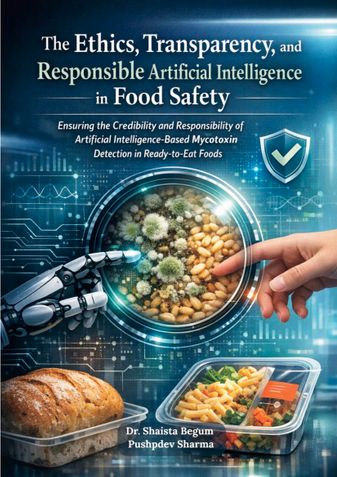
The Ethics, Transparency, and Responsible Artificial Intelligence in Food Safety (eBook)
Ensuring the Credibility and Responsibility of Artificial Intelligence-Based Mycotoxin Detection in Readyto-Eat Foods
Type:
e-book
Genre: Education & Language
Language: English
Price:
₹0
Description
The food supply chains are also getting interlaced, and the number of ready-to-eat foods is
growing as well, which complicates the process of food safety assurance, as regards mycotoxin
contamination. The carcinogenic, immunotoxic, and neurotoxic effects of mycotoxins are a
serious concern to the population, and there is therefore a need to identify them early enough
and deal with the risk successfully. AI has been seen to become a transformative ingredient in
food safety systems with an ability to detect quickly, monitor in real time, and predict the
potential risks at the production phase, storage phase, and distribution phase. It is endeavoured
to highlight the application of AI-based mycotoxin detection in ready-to-eat food items and its
ethical parameters, and its adoption. Besides technical performance, the chapter emphasizes
the fact that the AI system is not value-neutral and it should be limited by strong ethical
principles. The primary ethical principles of beneficence, non- maleficence, fairness,
transparency, accountability, and human autonomy are touched upon in relation to AIsupported decision making, such as batch rejection, recalls, and regulatory reporting. Particular
attention is given to the problems of the algorithmic bias, quality of data, limitation of
sampling, and the threat of automation. The importance and validity of explicable AI
governance with human interface, clear and transparent dealings are emphasised for the
maintenance of regulatory compliance and trust.
About the Authors
Book Details
ISBN: 9789347142123
Publisher: AgniLeaf
Number of Pages: 31
Availability:
Available for Download (e-book)
Ratings & Reviews
The Ethics, Transparency, and Responsible Artificial Intelligence in Food Safety
Review This Book
Write your thoughts about this book.

Currently there are no reviews available for this book.
Be the first one to write a review for the book The Ethics, Transparency, and Responsible Artificial Intelligence in Food Safety.
Other Books in Education & Language
Amit Kumar

GIRISH ATHALYE

Ujjawala Singh