You can access the distribution details by navigating to My pre-printed books > Distribution
Add a Review
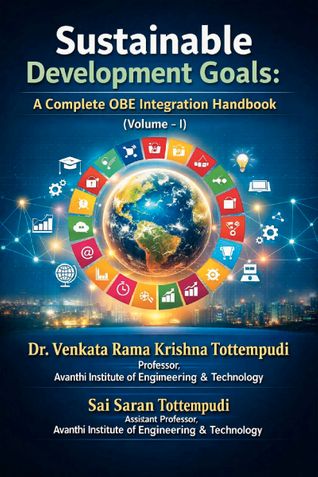
Sustainable Development Goals: A Complete OBE Integration Handbook (Volume-I) (eBook)
Type:
e-book
Genre: Self-Improvement
Language: English
Price:
₹100
(Immediate Access on Full Payment)
Description
This volume presents a comprehensive framework for integrating the Sustainable Development Goals (SDGs) into the Outcome-Based Education (OBE) system within higher education institutions (HEIs), with a prime focus on engineering and technology programs. The framework transforms sustainability from an abstract global vision into a measurable, assessable, and achievable academic objective by aligning SDG indicators with clearly defined learning outcomes and structured attainment processes within OBE.
The model is built on a hierarchical integration philosophy, beginning with institutional policies—including strategic plans, sustainability governance structures, and academic charters—and cascading down to program-level outcomes, course outcomes, teaching–learning strategies, assessment tools, and student activities. SDG mapping is systematically carried out through structured matrices that evaluate alignment strength (3 = Strong, 2 = Moderate, 1 = Low) across COs, POs, PSOs, and national policy initiatives such as NEP-2020, Smart Cities Mission, Jal Jeevan Mission, and the National Action Plan on Climate Change (NAPCC). This ensures curriculum relevance to national priorities and global sustainability expectations.
Pedagogically, the handbook embeds sustainability across the curriculum using SDG-linked laboratory experiments, real-world case studies, project-based learning (PBL), and sustainability-focused assignments. The OBE structure supports measurable assessment of sustainability competencies through rubrics, mini-projects, field activities, and reflection-based evaluations. SDG attainment is calculated using weighted CO-linked matrices, enabling continuous monitoring across CO, PO, PSO, and SDG levels through both direct (exam, project) and indirect (survey, feedback) assessments. The framework integrates seamlessly with Continuous Quality Improvement (CQI) cycles, enabling faculty and departments to identify gaps, implement corrective measures, revise curriculum components, and maintain dynamic SDG alignment.
The expected outcomes demonstrate substantial academic and societal benefits. Students develop essential graduate attributes such as systems thinking, environmental and ethical literacy, responsible decision-making, and sustainable design capabilities—preparing them to address complex global challenges with innovation and integrity. Institutions benefit through strengthened accreditation readiness for NBA and NAAC, enhanced research output in SDG domains, and greater visibility in sustainability-driven global rankings. The model further supports the development of student-led start-ups and research initiatives in areas such as renewable energy, smart cities, and climate action.
In essence, the OBE framework acts as the architectural blueprint of academic design, while SDG integration adds the sustainability features necessary for responsible and future-ready education. Through structured mapping, attainment, and documentation processes, this handbook provides a rigorous quality assurance mechanism, ensuring that sustainability is not merely taught, but meaningfully embedded, practiced, and demonstrated across the entire educational ecosystem.
About the Authors
Book Details
Publisher: Self
Number of Pages: 443
Availability:
Available for Download (e-book)
Ratings & Reviews
Sustainable Development Goals: A Complete OBE Integration Handbook (Volume-I)
Review This Book
Write your thoughts about this book.

Currently there are no reviews available for this book.
Be the first one to write a review for the book Sustainable Development Goals: A Complete OBE Integration Handbook (Volume-I).
Other Books in Self-Improvement
DR. AVIJIT GHOSH
சர்தார் பரம்ஜித் சிங்

Suresh Ramaswamy
LivingInWellbeing, Dr. Purushothaman