You can access the distribution details by navigating to My pre-printed books > Distribution
Add a Review
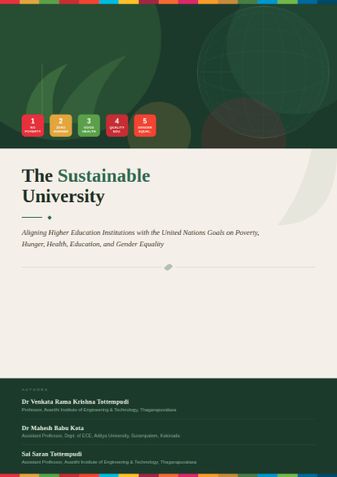
The Sustainable University: Aligning Higher Education Institutions with the United Nations Goals on Poverty, Hunger, Health, Education, and Gender Equality (eBook)
Type:
e-book
Genre: Self-Improvement
Language: English
Price:
₹300
(Immediate Access on Full Payment)
Description
Higher Education Institutions (HEIs) stand at the crossroads of knowledge creation, social transformation, and sustainable development. As the world grapples with unprecedented challenges including persistent poverty, food insecurity, health crises, educational inequities, and gender discrimination, universities are uniquely positioned to accelerate progress toward the United Nations Sustainable Development Goals (SDGs). This comprehensive framework examines the critical alignment of HEIs with SDGs 1 through 5—End Poverty, Zero Hunger, Good Health and Well-being, Quality Education, and Gender Equality—demonstrating how academic institutions can transcend their traditional roles as centers of learning to become powerful catalysts for societal change.
The imperative for sustainable universities extends beyond institutional compliance; it represents a fundamental reimagining of higher education's purpose in the 21st century. Universities possess unique assets—intellectual capital, research infrastructure, community networks, and influence over future leaders—that position them as essential contributors to the UN's 2030 Agenda. However, translating these assets into measurable impact requires systematic integration of sustainability principles into institutional DNA, spanning governance, operations, curriculum, research, and community engagement.
SDG-1: End Poverty in All Its Forms demands that universities address poverty not merely as an external phenomenon to study, but as a challenge directly impacting their communities. Progressive HEIs are implementing multifaceted poverty alleviation strategies including needs-based scholarships ensuring educational access for economically disadvantaged students, skill development programs targeting employability and entrepreneurship, community outreach initiatives providing financial literacy and livelihood training, and research-driven policy recommendations informing government poverty reduction programs. The establishment of social enterprise incubators, microfinance support cells, and industry-academia partnerships creates pathways from education to economic empowerment. Documentation mechanisms tracking scholarship disbursements, beneficiary outcomes, and poverty impact assessments provide accountability while demonstrating universities' contributions to breaking intergenerational poverty cycles.
SDG-2: Zero Hunger positions agricultural universities and research institutions as frontline warriors against food insecurity. Universities are pioneering sustainable agriculture through research on climate-resilient crops, biofortification, and precision farming technologies. Campus farms serve dual purposes as living laboratories and community food sources, while student volunteer programs in neighboring villages transfer agricultural knowledge to smallholder farmers. Innovations in food processing, supply chain optimization, and nutrition research directly address the dual burden of hunger and malnutrition. Universities are documenting their impact through metrics including acres under sustainable cultivation, farmers trained, nutritional interventions implemented, and research publications advancing food security science. Partnerships with ICAR, agricultural departments, and NGOs amplify institutional reach, transforming theoretical knowledge into field-level impact.
SDG-3: Good Health and Well-being recognizes universities as health ecosystem anchors, particularly in underserved regions. Medical colleges and health science institutions operate community health centers providing affordable primary care, while regular health camps deliver preventive services including immunization, cancer screening, and chronic disease management to thousands. Mental health initiatives, increasingly critical in academic environments, include professional counseling services, peer support networks, suicide prevention programs, and campus-wide wellness campaigns. Research contributions in epidemiology, public health, and medical innovation advance national health objectives. POSH Act compliance, tobacco-free campus policies, and comprehensive health insurance for students demonstrate institutional commitment to well-being. Universities document health impact through patient statistics, health camp beneficiaries, counseling sessions conducted, and research outcomes, positioning themselves as vital public health infrastructure.
SDG-4: Quality Education represents both universities' core mission and their most direct SDG contribution. The National Education Policy (NEP) 2020 alignment catalyzes transformative changes including the 5+3+3+4 curricular structure replacing rigid 10+2 frameworks, Academic Bank of Credits enabling flexible learning pathways, multidisciplinary education breaking disciplinary silos, integration of Indian Knowledge Systems honoring traditional wisdom, and technology-enabled learning democratizing access. Universities are implementing outcome-based education, experiential learning, and competency-based assessment while expanding community outreach through adult literacy programs, teacher training initiatives, and mobile learning vans reaching remote areas. The establishment of Centres of Excellence, appointment of SDG coordinators, and mandatory alignment of doctoral research with sustainability goals institutionalize quality education commitments. Documentation includes enrollment data disaggregated by gender and social category, completion rates, faculty development programs, research outputs, and community education metrics, demonstrating universities' multidimensional educational impact.
SDG-5: Gender Equality demands that universities model the inclusive societies they aspire to create. Achieving gender parity extends beyond enrollment statistics to encompass leadership representation, safety, support services, and cultural transformation. Progressive institutions target 50% women in leadership positions, from departmental heads to governance boards, recognizing that balanced decision-making strengthens institutional excellence. POSH Act 2013 compliance through functional Internal Complaints Committees, comprehensive complaint handling mechanisms, and zero-tolerance policies creates safe learning and working environments. Infrastructure investments including women's hostels, crèche facilities, sanitary amenities, and gender-sensitive campus design support women's full participation. Scholarships targeting women in STEM fields, entrepreneurship cells, leadership development programs, and mentoring initiatives address systemic barriers. Gender-responsive budgeting allocates dedicated resources for women's empowerment while monitoring systems track progress across quantitative indicators including Gender Parity Index, women in leadership percentages, and scholarship beneficiaries, alongside qualitative measures assessing institutional culture and support effectiveness.
Cross-Cutting Implementation Strategies integrate these goals into cohesive sustainability frameworks. Institutional governance reforms include establishing SDG coordination centers, appointing faculty coordinators for each goal, allocating minimum 10% of budgets to SDG-related research, and mandating 100% doctoral thesis alignment with SDGs. Community engagement models—literacy labs, mobile learning vans, SDG radio broadcasting, Hub-Spoke approaches covering 5km radii—extend university impact beyond campus boundaries. Quality assurance mechanisms embed SDG indicators in NAAC criteria, NBA outcomes, and NIRF parameters, ensuring accreditation processes reward sustainability commitments.
Monitoring, Evaluation, and Impact Assessment transform aspirations into accountability through comprehensive data collection systems tracking target-wise activities, evidence documentation, NAAC/NIRF compliance mapping, and scoring frameworks measuring progress. Regular audits assess policy implementation, infrastructure adequacy, program effectiveness, and outcome achievement, generating insights for continuous improvement while demonstrating credible impact to stakeholders.
About the Authors
Book Details
Publisher: Self
Number of Pages: 984
Availability:
Available for Download (e-book)
Ratings & Reviews
The Sustainable University: Aligning Higher Education Institutions with the United Nations Goals on Poverty, Hunger, Health, Education, and Gender Equality
Review This Book
Write your thoughts about this book.

Currently there are no reviews available for this book.
Be the first one to write a review for the book The Sustainable University: Aligning Higher Education Institutions with the United Nations Goals on Poverty, Hunger, Health, Education, and Gender Equality.
Other Books in Self-Improvement

Som Bathla

Lalit Bhonsle

Guru Shri Mothi Matthew Ashraf (Asraf Ali)

Nirav Shah