You can access the distribution details by navigating to My pre-printed books > Distribution
Add a Review
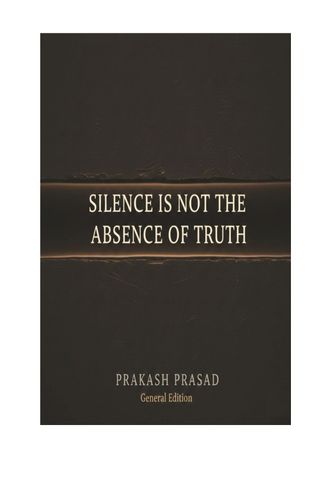
Silence Is Not the Absence of Truth (eBook)
Understanding Silence, Authority, and Accuracy in High-Resistance Interviews
Type:
e-book
Genre: Social Science, Self-Improvement
Language: English
Price:
₹4,999
(Immediate Access on Full Payment)
Description
Silence Is Not the Absence of Truth explores what actually happens when people hesitate, withhold information, or comply too quickly during serious conversations. Rather than treating silence as an obstacle, this book examines it as a meaningful signal shaped by authority, pressure, risk, and human cognition.
Drawing on investigative practice, behavioral science, and real-world observation, the book explains why accuracy often breaks down in interviews—not because of poor questions, but because of subtle forces that narrow what people feel able to say. It addresses how pressure alters memory, how authority reshapes disclosure, and why over-compliance is frequently mistaken for cooperation.
The focus throughout is ethical, non-coercive practice. This is not a guide to interrogation, persuasion, or psychological tactics. Instead, it offers frameworks for recognizing different forms of resistance, working productively with silence, and creating conditions where reliable information can emerge without manipulation or force.
Readers will gain insight into how hesitation functions, how timing affects recall, and how restraint often produces better outcomes than urgency. The book emphasizes observation over interpretation, clarity over control, and long-term credibility over short-term compliance.
Written for investigators, interviewers, journalists, compliance professionals, analysts, and others who work with reluctant or cautious sources, the principles apply across professional contexts where stakes are high and accuracy matters. No prior background in psychology is required; the approach is practical, grounded, and accessible.
This general edition focuses on the foundational principles of high-resistance interviews and serious communication. A separate law enforcement application edition expands on these ideas within badge-specific and procedural contexts.
At its core, Silence Is Not the Absence of Truth argues that effective interviewing is less about getting people to talk and more about understanding what makes truth possible.
About the Author
Book Details
Number of Pages: 108
Availability:
Available for Download (e-book)
Ratings & Reviews
Silence Is Not the Absence of Truth
Review This Book
Write your thoughts about this book.

Currently there are no reviews available for this book.
Be the first one to write a review for the book Silence Is Not the Absence of Truth.
Other Books in Social Science, Self-Improvement
Sandeep Bhansali, Gomti Prasad Yadav, Kamaldeep Singh, Chumki ...

Navin Sinha

LivingInWellbeing, Dr. Purushothaman