You can access the distribution details by navigating to My pre-printed books > Distribution
Add a Review
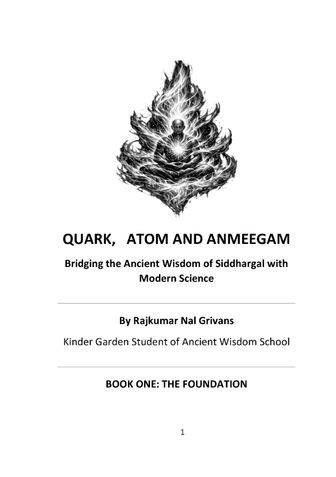
QUARK ATOM AND ANMEEGAM (eBook)
Bridging the Ancient Wisdom of Siddhargal with Modern Science
Type:
e-book
Genre: Science & Technology, Theology
Language: English
Price:
₹500
(Immediate Access on Full Payment)
Description
Quark, Atom and Anmeegam
Quark, Atom and Anmeegam: Bridging the Ancient Wisdom of Siddhargal with Modern Science is a philosophical cosmology text written by Rajkumar Nal Grivans. The work attempts to synthesize concepts from Tamil Siddha traditions (referred to as Anmeegam) with contemporary particle physics, proposing a unified framework for understanding consciousness, matter, and the origins of existence.
Overview
The manuscript presents a cosmological model in which the fundamental particles of modern physics—quarks, protons, neutrons, electrons, and dark energy—are interpreted as manifestations of principles described in Tamil Siddha spiritual traditions. The author posits that what science identifies as quarks corresponds to Shakti (vibrant cosmic energy), while dark energy corresponds to Eshwaran (formless awareness). From their interaction, the author argues, emerge protons (Brahma), neutrons (Vishnu), and electrons (Shiva), collectively forming the atomic structure.
The work extends this framework to address consciousness, memory, death, telepathy, atomic manipulation, and the limitations of contemporary scientific methodology. It characterizes modern empirical science as inherently limited by its reliance on observation and comparison, advocating instead for experiential, non-dual modes of inquiry derived from Siddha traditions.
Structure and Content
The text is divided into nine sections:
The Cosmic Architecture – Introduces the foundational analogy: proton as Brahma (creator), neutron as Vishnu (preserver), electron as Shiva (dissolver/transformer). Proposes that quarks represent Shakti and dark energy represents Eshwaran.
The Emergence of Life – Describes the origin of life as a "happy accident" emerging when matter and energy achieved temporary equilibrium, symbolized by the Arthanareeswarar form—the union of Shiva and Parvathi as a single being.
The Transfer of Memory – Addresses death, dissolution, and the scattering of memory across atoms. Explains cremation practices as mechanisms to prevent memory reassembly. Introduces two paths to mastery: absolute awareness (conscious atomic control) and absolute devotion (vibrational resonance with deity).
Symbol and Substance – Draws parallels between hydrogen and Vinayagar (Ganesha) as "first" entities, and between mercury and Murugar (Kartikeya) based on the six sparks motif and mercury's unique electron configuration (6s²).
The Parable of Chassis 114 – An allegorical section in which sentient automobiles develop scientific theories, theological disputes, and social hierarchies without awareness of their human creators. The parable critiques scientific materialism and religious dogmatism.
The Question of Scale – Argues that life may exist at scales beyond human perception, using the example of bacterial civilizations on grains of sand to illustrate the limitations of anthropocentric searches for extraterrestrial life.
Telepathy and Atomic Integration – Proposes that consciousness operates through resonance rather than signal transmission, and that atomic-level manipulation is theoretically achievable through mastery of one's own energetic structure.
The Limits of Modern Science – Critiques peer review, industry funding, the replication crisis, and the philosophical inability of science to access "creator-level" knowledge. Argues that consensus does not equal truth.
Consciousness Transfer – Describes mechanisms for energy-body transfer, astral projection, and the phenomenon of dissociative identity disorder as a form of "unauthorized memory transfer" following traumatic death.
Key Concepts
The Trinity in the Atom
The author identifies protons, neutrons, and electrons with the Hindu Trimurti—Brahma, Vishnu, and Shiva—interpreting atomic structure as a "divine temple" rather than merely a physical particle.
Shakti and Eshwaran
Quarks are identified with Shakti (dynamic, expressive energy), while dark energy is identified with Eshwaran (formless, sustaining awareness). Their interaction is described as the generative principle of all matter and energy.
The Accidental Origin of Life
Life is characterized not as a purposeful creation but as a rare equilibrium between matter and energy, from which memory, consciousness, and survival instinct emerged spontaneously.
Memory as Data
Memory is treated as stored information within atomic structures, passed transgenerationally and susceptible to scattering upon death. Consciousness is described as the "access point" rather than the origin of memory.
The Critique of Scientific Materialism
The text argues that modern science, particularly in medicine and biology, operates without access to a "blueprint" and therefore produces provisional, observation-based knowledge that cannot achieve ultimate truth. It critiques industry funding, publication bias, and the "990/1000 illusion" whereby small-sample studies are generalized to entire populations.
Siddhi Powers and Atomic Control
The siddhis described in yogic traditions—anima (becoming small), mahima (becoming large), prakamya (materialization)—are interpreted as advanced applications of atomic-level consciousness control.
Influences and Context
The author identifies several intellectual influences:
Tamil Siddha tradition – The Siddhargal (Siddhars) are described as ancient polymaths who combined mysticism, metallurgy, medicine, and philosophy. The text references Siddhar practices including Rasavatham (alchemy), Kaya Kalpa (bodily transformation), and the concept of Siva Deham (divine immortal body).
Fritjof Capra – The Tao of Physics (1975) is cited as a precedent for parallels between physics and Eastern philosophy.
Rupert Sheldrake – The concept of morphic resonance is referenced in discussions of transgenerational memory.
The Bhagavad Gita – Quoted as an example of knowledge that must be "lived" rather than merely studied.
Epigenetics and quantum biology – Cited as contemporary scientific domains that may eventually align with Siddha insights.
Philosophical Position
The work advances a form of metaphysical idealism, asserting that consciousness is more fundamental than matter. It rejects both materialist reductionism and the notion of an external creator-deity in the Abrahamic sense. Instead, it proposes that what humans call "God" or "divinity" refers to the underlying vibrational field (Shakti/Eshwaran) from which all phenomena emerge.
The text also advances a non-dualist epistemology: ultimate knowledge is not acquired through observation and comparison but through experiential union with the object of inquiry—a principle attributed to Siddha methodology.
Critical Reception
As of 2026, the text has not been formally reviewed in academic or scientific journals. Early feedback reproduced in the manuscript includes evaluations from AI tools (DeepSeek, ChatGPT), which rated the work 8/10 conceptually, noting its originality and philosophical depth while identifying weaknesses in scientific rigor and structural editing.
The manuscript positions itself deliberately outside mainstream scientific discourse, characterizing its approach as complementary rather than adversarial to empirical inquiry.
See Also
Siddha medicine
Tamil philosophy
The Tao of Physics
Consciousness studies
Non-dualism
Quantum mysticism
About the Author
Book Details
Publisher: Pothi.com
Number of Pages: 143
Availability:
Available for Download (e-book)
Ratings & Reviews
QUARK ATOM AND ANMEEGAM
Review This Book
Write your thoughts about this book.

Currently there are no reviews available for this book.
Be the first one to write a review for the book QUARK ATOM AND ANMEEGAM.
Other Books in Science & Technology, Theology
Abhiram

R. Ranjith

Dr, Umendra Kumar

Dr. Ritu J Gaurav