You can access the distribution details by navigating to My pre-printed books > Distribution
Add a Review
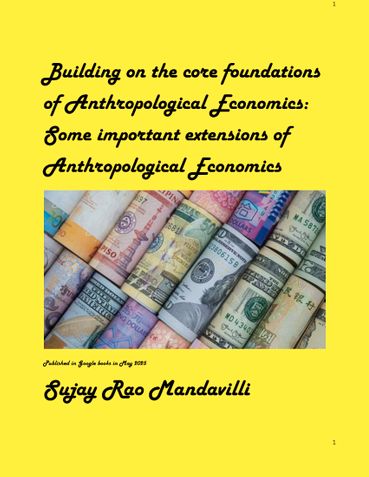
Building on the core foundations of Anthropological Economics: Our second tranche of extensions on Anthropological Economics (eBook)
Type:
e-book
Genre: Science & Technology
Language: English
Price:
₹500
(Immediate Access on Full Payment)
Description
The concepts of anthropological economics were introduced by us in the year 2020 in a paper entitled
“Introducing Anthropological Economics: The quest for an Anthropological basis for Economic theory,
growth models and policy development for wealth and human welfare maximization” and was published
in the journal ELK Asia Pacific Journal of Social Sciences Volume 6, Issue 3 (April –June 2020). The paper
was subsequently published in Google books later in the same year.
We had also published the following papers subsequently, and these papers were compiled into a
subsequent volume that was published by us a couple of years later. The name of the second volume
was “Building on the core foundations of Anthropological Economics: Some important extensions of
Anthropological Economics”, and it was published by us in Google books in May 2025:
1. Delineating “Cultural limits” and “Anthropological limits” as central theorems in the social
sciences: Some more useful and practicable techniques for social sciences research (SSRN, July
2024)
2. Isolating Anthropological factors that determine economic performance or non-performance: A
meritorious way forward in Anthropological Economics, SSRN, January 2025
3. Measuring economic performance against “Cultural limits” and “Anthropological limits”:
Techniques and strategies for better economic planning and economic modeling (SSRN, July
2024)
4. Expounding the concepts of socio-cultural advantage, and cultural and anthropological
equilibrium: More core concepts in Anthropological Economics, SSRN, May 2025
5. Propounding the science of “Motivational economics”: Another crucial component of the
science of Anthropological Economics, SSRN, May 2025
6. Extolling the virtues of ethnography in economic planning and decision-making: Mainstreaming
“Econoethnography” in Anthropological Economics
The objective of our work on anthropological economics has been to attempt to merge the concepts and
theoretical frameworks of the disciplines of Anthropology and Economics, thereby creating a new sub
field in Economics called ‘Anthropological Economics’ which is mired in Anthropological concepts and
principles and sought to maximize not only human welfare and happiness but also wealth maximization
across cultures, while considering both the psychic unity of man, universal human needs and
culturespecific factors. Thus, the field of Anthropological Economics is expected to be inter-related to
other disciplines of Economics, but remain complementary to them i.e., it is not expected that it would
intrude into other sub-fields of economics, replace them, or override their principles in any way. It
would therefore we anticipated, draw upon other aspects of economic theory, and enrich them suitably.
It is therefore expected that all aspects of Economic theory would be taken into consideration for policy
formulation and decision-making, including those of Anthropological economics, and independent,
context-specific judgment would always be applied. The new and novel proposed field of
Anthropological Economics proposes to take the idea of Human Welfare to its logical conclusion by
extending the work already carried out in various sub-disciplines of economics such as those proposed
by Amartya Sen and others, and integrate it more tightly with various concepts in Anthropology. Many
new tools and techniques have therefore, been proposed as a part of our overall work, and we believe
these would suitably enrich the field of Economics as well. While many attempts have been made in the
past to integrate the fields of Anthropology and Economics, we hope, anticipate, expect and believe that
3
our endeavour would take this exercise to a much higher level, by creating a new generation of
“Anthroeconomists”. We also hope that it will eventually help move mainstream economics away from
Neo-classical approaches (what we prefer to call legacy economics at this point in time) to
Anthropological and human-centric approaches. The present volume presents our second tranche of
additional and auxiliary concepts in anthropological economics. The present volume must be read after
the contents of the first two previous volumes have been fully read and ingested. We say this in the
interests of absolute reader clarity. This is because the original paper and the previous extensions have
not been reproduced here.
In the following second extension comprising a further set of additional papers, the following papers are
added:
1. Anatomizing a GINI coefficient and Lorenz curve: Towards sociocultural investigations for
improved economic and sociocultural performance
2. Disentangling the concept of a phugoid cycle in anthropological economics: A brief study of its
types, workings, implications and ramifications
3. Regularizing cross-cultural and intra-cultural static and dynamic analyses in anthropological
economics: Another vital tool for research in anthropological economics
4. Commissioning a “population composition analysis” as a part of anthropological economics: Yet
another vital indicator of economic performance
The above extensions must be read together with the works of Wassily Leontief and others, and it the
case of the phugoid cycle, high exchange rates causing downfall of economies, outsourcing and other
factors need to be taken into account and consideration. Therefore anthropological economists need to
work together, and in conjunction with other mainstream economists. In addition, we also present our
work on the degrowth delusion here. While not directly linked to anthropological economics, it shows
clearly that left-wing notions of degrowth are highly fallacious and unworkable, and that bottom up, and
trieckle up development models are the only way out, at least for developing countries. The name of the
paper is as follows, and it was published by us in August 2025:
1. The degrowth delusion: Why technology and sustainable development models alone will solve
the world’s environmental woes in the long-term .................
About the Author
Book Details
Number of Pages: 195
Availability:
Available for Download (e-book)
Ratings & Reviews
Building on the core foundations of Anthropological Economics: Our second tranche of extensions on Anthropological Economics
Review This Book
Write your thoughts about this book.

Currently there are no reviews available for this book.
Be the first one to write a review for the book Building on the core foundations of Anthropological Economics: Our second tranche of extensions on Anthropological Economics.
Other Books in Science & Technology

Niraj Gupta

Subodh Sarkar

Dr.M. BALA THEJA

Ancient Philosophy