You can access the distribution details by navigating to My pre-printed books > Distribution
Add a Review
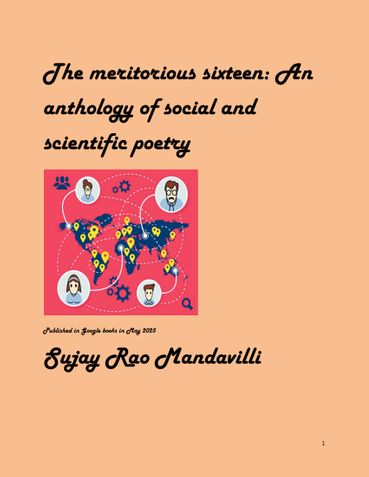
The meritorious sixteen: An anthology of social and scientific poetry (eBook)
Type:
e-book
Genre: Poetry
Language: English
Price:
₹500
(Immediate Access on Full Payment)
Description
Poetry in some way or the other, and in some form or the other, touches our daily lives in multiple and
in myriad ways, often beautifully and touchingly. Poetry dates back to prehistoric times, and has been
found in diverse cultures and diverse regions of the world such as Asia, Africa and Europe. In a vast
majority of cases, formal, written poetry branched out from oral poetic traditions, and in some cases,
folk songs. The oldest surviving epic poem, known as the Epic of Gilgamesh, dates from the third
millennium before Christ in Sumer (in Mesopotamia, in present-day Iraq), and was written
in cuneiform script on clay tablets and, later, on papyrus. Loosely and crudely defined, poetry is a form
of literary art that uses aesthetic and rhythmic techniques to bring out deeper and hidden meanings and
bring about a maximum emotional and psychological impact on the reader. It can also be used to convey
a deep and hidden meaning on a set of topics related to social cultural and scientific issues: This, as a
matter of fact, is a particular hallmark of social and scientific poetry. This is what we deal with in this
anthology of social and scientific poetry, as we hope they create maximal impact on readers and
gradually but willy-nilly bring about social and cultural change in societies particularly emerging and
developing ones. This is a potential major use of poetry but has not been tapped into or realized fully
and completely. Some other forms of poetry are less serious and deal with other aspects such as love,
war and chivalry. We do not deal with such classes and categories of poetry here. Poets and poetry also
make use of a wide variety of techniques called poetic devices, such as alliteration, onomatopoeia,
assonance, rhythm, euphony, cacophony, metre, and sound symbolism, in order to produce verse,
structure, format, symphony, pleasant harmony, musical or other acoustic and artistic effects. There are
many different forms of poetry such as epics, limericks, hymns (Such as the ancient Indian Rig Veda) and
ballads, some of them being unique trademarks of particular cultures or ethnic groups; famous
contemporary poets and poets of yore have included William Wordsworth, Edgar Allan Poe, William
Blake, Rudyard Kipling, WH Auden, and others. Rumi was a famous non-English Islamic poet, and was an
eminent and a very famous theologician to boot. Homer’s Illiad and Odyssey also stand out in this
context. Poetry continues to change and evolve in the twenty-first century, and traditional forms of
poetry are being increasingly challenged. We therefore are witnessing the birth of postmodernist and
other schools of thought, and these are essentially work in progress at this stage. Poetry is also often
read out in popular public audiences and is accompanied by music, song, drama and vibrant theatre. We
do not wish to get into all of them here, but would hope, anticipate and expect that readers enjoy and
make best use of our poems. The following are our meritorious sixteen from our perspective and these
drive home the core and central mission of the globalization of science movement aptly and succinctly.
We hope that readers will not only enjoy them but will also take in and soak in their message.
About the Author
Book Details
Number of Pages: 98
Availability:
Available for Download (e-book)
Ratings & Reviews
The meritorious sixteen: An anthology of social and scientific poetry
Review This Book
Write your thoughts about this book.

Currently there are no reviews available for this book.
Be the first one to write a review for the book The meritorious sixteen: An anthology of social and scientific poetry.
Other Books in Poetry
प्रवेश कुमार, अविरल त्रिपाठी
मनीष कुमार अग्रवाल
Chirag Jain
Bikram Snehi