You can access the distribution details by navigating to My pre-printed books > Distribution
Add a Review
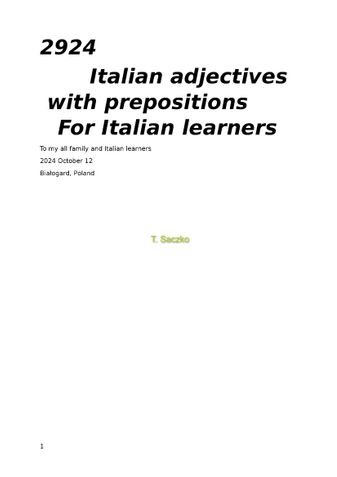
2924 Italian adjectives with prepositions For Italian learners (eBook)
Type:
e-book
Genre: Education & Language
Language: English, Italian
Price:
₹860
(Immediate Access on Full Payment)
Description
Introduction
to 2924 Italian Adjectives with Prepositions in Sentences For English Speakers: Bridging Grammar and Fluency
Language learners know that the path to fluency is paved not just with vocabulary and verb conjugations, but with mastering the subtle, often unpredictable relationships between words. For English speakers tackling Italian, few challenges are as pervasive—or as perplexing—as pairing adjectives with the correct prepositions. Why do Italians say felice di (happy about), arrabbiato con (angry with), or ricco di (rich in)? Why does interessato a (interested in) demand a different preposition than its English counterpart? These combinations, essential for precise expression, often defy direct translation, leaving learners to navigate a labyrinth of rules, exceptions, and regional variations.
2924 Italian Adjectives with Prepositions in Sentences For English Speakers is a definitive guide designed to turn this labyrinth into a roadmap. Unlike traditional phrasebooks or dry grammatical lists, this book immerses you in the living fabric of Italian by presenting each adjective-preposition pair within authentic, contextualized sentences. With 2924 carefully curated examples, you’ll not only memorize these critical combinations but also internalize how and when to use them—whether you’re describing emotions, opinions, relationships, or physical traits.
Why This Book?
For English speakers, Italian prepositions can feel like a minefield. The overlap with English usage is sporadic, and the logic behind Italian’s di, a, da, con, per, and su often seems opaque. A misplaced preposition can distort meaning, turning “I’m excited about the trip” into an awkward Sono eccitato sul viaggio (incorrect) instead of the correct Sono entusiasta del viaggio. This book tackles these hurdles head-on by:
• Providing clarity through context: Each adjective-preposition pair is illustrated in multiple sentences, reflecting real-life scenarios like travel, work, and social interactions.
• Highlighting contrasts with English: Notes on “false friends” and common translation errors help you avoid pitfalls (e.g., sicuro di vs. “sure of” vs. “safe from”).
• Organizing entries thematically and alphabetically: Quickly find phrases related to emotions (contento di, triste per), descriptions (pieno di, vuoto a), or professional contexts (responsabile di, esperto in).
• Demystifying cases and regional quirks: Understand when prepositions trigger definite articles (del, alla) and how usage varies between Northern and Southern Italy.
Beyond Grammar: Cultural Nuance
Language is a mirror of culture, and Italian’s adjective-preposition pairs often reveal deeper societal values. For instance, the frequent use of di in expressions like orgoglioso di (proud of) or stanco di (tired of) reflects a language that ties identity and emotion closely to relationships and experiences. This book weaves in cultural insights to help you grasp not just the “how” but the “why” behind these structures, enriching your communication with authenticity.
How to Use This Resource
Approach this book as both a reference and a workbook. Flip to the thematic chapters to prepare for specific situations, like writing a cover letter (adatto a, qualificato per) or navigating a conversation about family (legato a, preoccupato per). Use the example sentences as templates for your own practice, and test your knowledge with fill-in-the-blank exercises that reinforce retention. For advanced learners, dive into the nuances of literary or idiomatic usage, such as pazzo di (crazy about) in Italian pop music or libero da (free from) in political discourse.
The Journey Ahead
With 2924 combinations, this book is not about rote memorization—it’s about building intuitive mastery. As you progress, you’ll notice patterns emerging: how di often signals possession or content (una tazza piena di tè), how a can denote direction or purpose (utile a), and how con fosters connection (gentile con). These patterns will become tools, empowering you to think in Italian rather than translate from English.
2924 Italian Adjectives with Prepositions in Sentences is more than a grammar guide; it’s a bridge to fluency. Whether you’re composing an email, debating a friend, or losing yourself in an Italian novel, these pages will equip you to express nuance, emotion, and precision with confidence.
In bocca al lupo! (Good luck!)—and may your journey through Italian’s vibrant linguistic landscape be as rewarding as it is transformative.
About the Author
Book Details
Publisher: Tomasz Saczko
Number of Pages: 104
Availability:
Available for Download (e-book)
Ratings & Reviews
2924 Italian adjectives with prepositions For Italian learners
Review This Book
Write your thoughts about this book.

Currently there are no reviews available for this book.
Be the first one to write a review for the book 2924 Italian adjectives with prepositions For Italian learners.
Other Books in Education & Language
Sujoy Bag

Madan Gopal Goel
Devesh Gupta 'SIR'

Sujatha A. Krishna Rao