You can access the distribution details by navigating to My Print Books(POD) > Distribution
Add a Review
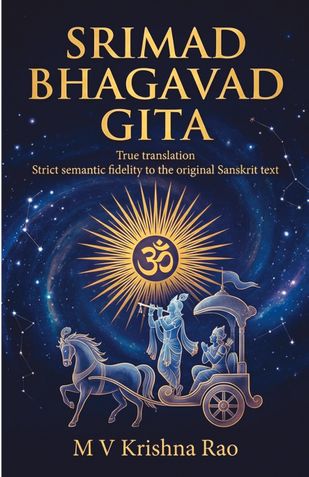
SRIMAD BHAGAVAD GITA True Translation Strict Semantic Fidelity to the Original Sanskrit Text
This book is continuation of Characters of Epic Mahabharata – Volume 5
M V Krishna RaoType:
Print Book
Genre: Religion & Spirituality
Language: English
Price:
₹281
+ shipping
Description
The Srimad Bhagavad Gita, often referred to simply as the Gita,
is widely regarded as the "Veda Saramsha" and constitutes one of
the most significant spiritual classics in world literature. Textually,
it appears as a philosophical dialogue nested within the Bhishma
Parva (Chapters 25–42) of the great Indian epic, the
Mahabharata, attributed to the sage Veda Vyasa.
.
This edition of the Srimad Bhagavad Gita presents a "true
translation" aiming for strict semantic fidelity to the original
Sanskrit text. Unlike many popular renditions that prioritise poetic
flow or sectarian interpretation, this work focuses on the precise,
literal meaning of each shloka (verse). The translation method
employed here is critical and philological; it seeks to convey the
exact intent of the original syntax while retaining key philosophical
terms—such as Dharma (duty/cosmic law), Yoga
(discipline/union), and Guna (mode of nature)—where English
equivalents fail to capture the necessary depth.
The text covers all 700 verses across the 18 chapters, maintaining
the dialogue format between Prince Arjuna and Lord Krishna.
This book is designed for the serious student of Vedanta and the
independent seeker who wishes to engage with the raw, unadorned
power of the scripture, stripped of the "weeds and underbrush" of
later theological overlays.
The Setting
The dialogue takes place on the "Dharma-kshetra" (Field of
Righteousness) of Kurukshetra, amidst the opposing armies of the
Pandavas and the Kauravas. It begins with the psychological
collapse of the warrior Arjuna, who is paralysed by a profound
moral crisis (Dharma-sankata) at the prospect of slaying his own
kinsmen. This dramatic setting serves as a backdrop for a discourse
that transcends the immediate battlefield to address the eternal
conflict within the human heart—the struggle to align the
individual will with the Divine Will.
The Structure
The 700 verses are traditionally divided into three hexads (shatkas),
or sections of six chapters, mirroring the Vedantic aphorism "Tat
Tvam Asi" (Thou Art That):
1. Karma Yoga (Chapters 1–6): Focuses on the "Thou"
(Tvam), or the individual soul (Jiva), teaching the
discipline of selfless action and the path to self-realisation.
2. Bhakti Yoga (Chapters 7–12): Focuses on the "That"
(Tat), or the Supreme Lord (Ishvara), elucidating the
nature of God and the path of devotion.
3. Jnana Yoga (Chapters 13–18): Focuses on the identity
(Asi) between the Self and the Supreme, analysing the
distinction between Matter (Prakriti) and Spirit (Purusha).
The Philosophy
The Gita is often called an "Upanishad" in its own right because it
distills the essence of Vedic wisdom into a practical manual for life.
A traditional verse metaphorically describes the Upanishads as the
cows, Lord Krishna as the milker, Arjuna as the calf, and the Gita
as the immortal milk. By harmonising the diverse paths of Action
(Karma), Devotion (Bhakti), and Knowledge (Jnana), the text
offers a comprehensive framework for spiritual liberation
(Moksha) that remains relevant to every human condition.
I. Textual Methodology and Philological Context
The Bhagavad Gita, comprising 700 verses (shlokas) arranged in 18
chapters (adhyayas), constitutes a philosophical dialogue nested
within the Bhishma Parva (Chapters 23–40) of the Indian epic,
the Mahabharata. The text functions as a "spiritual dictionary,"
synthesising the divergent streams of Vedic ritualism, Upanishadic
metaphysics, and the dualistic cosmology of Sankhya philosophy
into a cohesive soteriological framework.
This report provides an exhaustive, verse-by-verse literal translation
of the complete text. The translation methodology employed here
prioritises semantic precision and fidelity to the original Sanskrit
syntax. It eschews sectarian commentary in favour of a "true
translation" that reflects the literal meaning of the pada (word) and
vakya (sentence). Where English vocabulary lacks the conceptual
granularity of Sanskrit—particularly regarding terms like Dharma
(duty/cosmic law), Yoga (union/discipline), and Guna (mode of
nature)—the original Sanskrit term is retained or noted to preserve
philosophical integrity.
The text is traditionally divided into three hexads (shatkas), each
addressing a distinct theological and distinct pedagogical arc. The
translation below adheres to this structural division, presenting the
dialogue between Prince Arjuna and Lord Krishna (Hrishikesha)
as reported by the visionary narrator Sanjaya to the blind King
Dhritarashtra.
About the Author
Book Details
Publisher: M V Krishna Rao
Number of Pages: 118
Dimensions: 5.5"x8.5"
Interior Pages: B&W
Binding:
Paperback (Perfect Binding)
Availability:
In Stock (Print on Demand)
Ratings & Reviews
SRIMAD BHAGAVAD GITA True Translation Strict Semantic Fidelity to the Original Sanskrit Text
Review This Book
Write your thoughts about this book.

Currently there are no reviews available for this book.
Be the first one to write a review for the book SRIMAD BHAGAVAD GITA True Translation Strict Semantic Fidelity to the Original Sanskrit Text.
Other Books in Religion & Spirituality
By Enabled Version of You
Bhaktisiddhanta Sarasvati
Yogi Gupta
Shaikh Sayid Abdul Qadir Jeelani (RA)