You can access the distribution details by navigating to My Print Books(POD) > Distribution
Add a Review
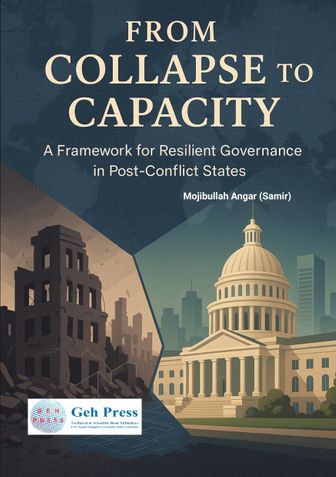
From Collapse to Capacity: A Framework for Resilient Governance in Post-Conflict States
Mojibullah Angar (Samir)
This book ships within India only.
Description
The concepts of state failure and state fragility have been central to political science and international relations discourse, particularly in the post-Cold War era. its State failure refers to the breakdown of a state's ability to perform core functions—ensuring security, maintaining rule of law, providing public services, and upholding legitimacy. According to Robert I. Rotberg (2003), a failed state is characterized by the inability to provide "political goods" to its citizens, such as internal and external security, justice, economic opportunity, and political participation. Rotberg emphasizes that state failure is most acutely visible in situations where violence becomes endemic, state institutions disintegrate, and the central authority loses effective control over significant portions of the territory.
About the Author
Book Details
ISBN: 9789367175224
Publisher: GEH Press
Number of Pages: 173
Dimensions: A5
Interior Pages: B&W
Binding:
Paperback (Perfect Binding)
Availability:
In Stock (Print on Demand)
Ratings & Reviews
From Collapse to Capacity: A Framework for Resilient Governance in Post-Conflict States
Review This Book
Write your thoughts about this book.

Currently there are no reviews available for this book.
Be the first one to write a review for the book From Collapse to Capacity: A Framework for Resilient Governance in Post-Conflict States.
Other Books in Education & Language

Dr. M. S. DEORE

Mohamed Fawzan

BINAY KUMAR SHUKLA

Ashokan Kannarath, Vijay Koshti