You can access the distribution details by navigating to My Print Books(POD) > Distribution
Add a Review
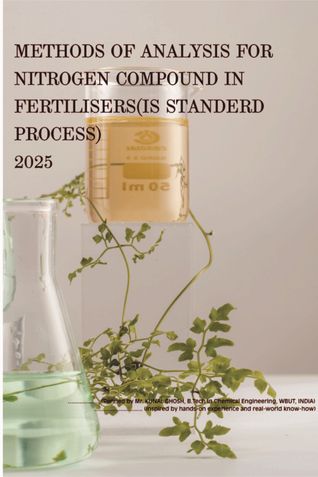
METHODS OF ANALYSIS FOR NITROGEN COMPOUND IN FERTILISERS(IS STANDERD PROCESS)
"Standard Laboratory Procedures in Accordance with Indian Standards for Quality Assessment of Fertilizers"
Mr.KunalGhoshType:
Print Book
Genre: Engineering, Science & Technology
Language: English, Hindi
Price:
₹199
+ shipping
This book ships within India only.
Description
The book would describe the standardized procedures and techniques used to determine the nitrogen content in various types of fertilizers, following Indian Standards (IS).(also include Flowchart for laboratory use)
Here's a breakdown of what such a book would generally cover:
1. Importance of Nitrogen Analysis in Fertilizers:
Nitrogen is a crucial macronutrient for plant growth.
Accurate determination of nitrogen content is essential for quality control of fertilizers, ensuring they meet specified standards and provide the advertised nutrient levels.It helps in compliance with regulations (like the Fertilizer Control Order in India).
2. Key Methods of Analysis: The book would detail various methods, likely including:
This is a classic and widely used wet chemistry method for determining total nitrogen in many organic and inorganic substances, including fertilizers. It involves three main steps:
Digestion: The sample is heated with concentrated sulfuric acid and a catalyst (e.g., potassium sulfate, copper sulfate, mercury, or selenium) to convert organic nitrogen into ammonium sulfate.
Distillation: The digested sample is made alkaline with sodium hydroxide, releasing ammonia gas, which is then distilled into a trapping solution (e.g., boric acid or standardized acid).
Titration: The trapped ammonia is then quantified by titrating with a standard acid solution.
The book would likely cover variations for nitrate-containing and nitrate-free samples.
Specific Methods for Different Nitrogen Forms: Fertilizers can contain nitrogen in various forms (ammoniacal, nitrate, amide/urea, organic). The book would likely provide specific methods for determining each form, and how to combine them for total nitrogen calculation:
Ammoniacal Nitrogen: Often determined by direct distillation or titration.
Nitrate Nitrogen: Methods might involve reduction to ammonia (e.g., using Devarda's alloy or chromium powder) followed by Kjeldahl-like distillation and titration.
Urea Nitrogen: Determined by methods like the urease method or formaldehyde titration.
3. Scope and Applicability:
The book would specify which types of fertilizers (straight, mixed, solid, liquid) each method is applicable to.
It would cover both inorganic and organic nitrogen-containing fertilizers.
4. Apparatus and Reagents:
Detailed descriptions of the necessary laboratory equipment (*Kjeldahl digestion and distillation units, Dumas analyzers, glassware, titrators*).
Specifications for reagents, their preparation, and storage.
5. Sample Preparation and Handling:
Procedures for collecting representative fertilizer samples.
Methods for preparing samples for analysis (e.g., grinding, homogenizing).
6. Calculation of Results:
Formulas and examples for calculating the percentage of nitrogen in the fertilizer based on titration volumes or instrument readings.
7. Quality Control and Validation:
Information on accuracy, precision, repeatability, and reproducibility of the methods.
8. Safety Precautions: Guidelines for handling hazardous chemicals (e.g., concentrated acids, strong bases) and operating lab equipment safely.
In essence, this book would be a practical guide for laboratory professionals and quality control personnel in the fertilizer industry, ensuring consistent and accurate measurement of nitrogen content as per Indian regulatory standards.
About the Author
Book Details
Publisher: Kunal Ghosh
Number of Pages: 71
Dimensions: 6.00"x9.02"
Interior Pages: B&W
Binding:
Paperback (Perfect Binding)
Availability:
In Stock (Print on Demand)
Ratings & Reviews
METHODS OF ANALYSIS FOR NITROGEN COMPOUND IN FERTILISERS(IS STANDERD PROCESS)
Review This Book
Write your thoughts about this book.

Currently there are no reviews available for this book.
Be the first one to write a review for the book METHODS OF ANALYSIS FOR NITROGEN COMPOUND IN FERTILISERS(IS STANDERD PROCESS).
Other Books in Engineering, Science & Technology
Ram Babu Sao
Lalit Mohan, Mahesh Chandra, Ashok K. Kakodia, Rakesh ...

Dr. M. S. DEORE

Ajinkya Vilas Tale (Patil)