You can access the distribution details by navigating to My Print Books(POD) > Distribution
Add a Review
Type:
Print Book
Genre: Religion & Spirituality
Language: English
Price:
₹750
+ shipping
Description
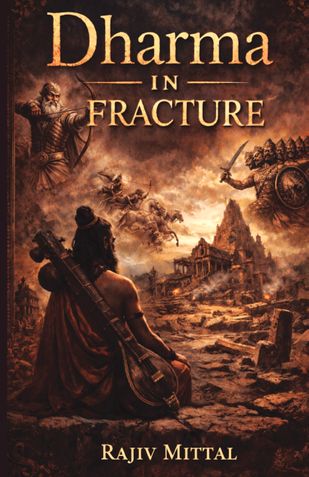
“A master of literary fiction... Rajiv Mittal’s prose is artistic and evocative, capturing mood and theme with in-depth character studies... His themes are complex, his tone serious, and his pacing deliberate... Dharma in Fracture is not a novel you read for pleasure. It’s a study in philosophy and emotional resonance that requires enormous concentration... a real treat for readers who appreciate philosophical depth.”
— Reedsy Discovery
The epics were never meant to be comforting. Over time, they were made so.
Their violence acquired moral language. Their silences were justified. Their compromises were explained until they felt inevitable. What survives is an interpretation that makes the past comfortable and allows us to feel morally superior.
Dharma in Fracture steps away from that comfort.
This trilogy does not retell the Mahabharata or the Ramayana. It engages with what they leave unresolved. It asks what happens when vows outlive their meaning, when obedience hardens into cruelty, and when endurance is praised simply because it preserves the world. The question is never who was right, but what the cost turned out to be.
Bhisma and Drona stand at the centre of an order that can no longer justify itself. Their loyalty has become structural rather than ethical, and their wisdom remains bound to systems they no longer know how to dismantle.
Ravana is a figure of formidable intelligence, sharpened by hierarchy and doctrine. His brilliance reinforces the very structures that imprison him. Knowledge becomes enforcement.
Karna is pushed toward a decision that cannot be cleansed by honour. When taunted by Ravana, he reacts, and they both emerge stronger for it.
Sita and Draupadi provide the unpredictable feminine shakti, raising questions the epics never closed.
At the centre stands Krishna. He does not explain himself or intervene. The universe he embodies responds to alignment rather than intention. The discomfort lies in recognizing how little morality matters in a universe governed by frequency and resonance.
As the Sarasvati changes course and inherited certainties erode, a deeper unease emerges. When survival demands aggression rather than restraint, inherited moral frameworks falter. Memories of Northern incursions, of places like Somnath broken and rebuilt, sit uneasily beside interpretations that condemn transgression without examining what survival has required.
In the final movement, Shankara walks through temples worn smooth by interpretation. Stones remember what people repeat without reflection. His attention lingers on what remains when faith must be recovered from habit rather than felt.
Framed through the weary voice of Narada, who has witnessed these patterns repeat too often to offer comfort, Dharma in Fracture stays with the point where stories stop instructing and start implicating. It suggests that destruction is not opposed to righteousness, but is often how it acts.
This is a book for readers willing to think with the epics rather than be guided by them. It asks what these stories have shaped in us and what their interpretations have taught us to endure.
About the Author
Book Details
ISBN: 9781763595835
Publisher: Self Published
Number of Pages: 238
Dimensions: 5.5"x8.5"
Interior Pages: B&W
Binding:
Paperback (Perfect Binding)
Availability:
In Stock (Print on Demand)
Ratings & Reviews
Dharma in Fracture
Review This Book
Write your thoughts about this book.

Currently there are no reviews available for this book.
Be the first one to write a review for the book Dharma in Fracture.
Other Books in Religion & Spirituality

P Hirson, J Rao


Dada Bhagwan
NIRANKAR NIRANJAN