You can access the distribution details by navigating to My Print Books(POD) > Distribution

Add a Review
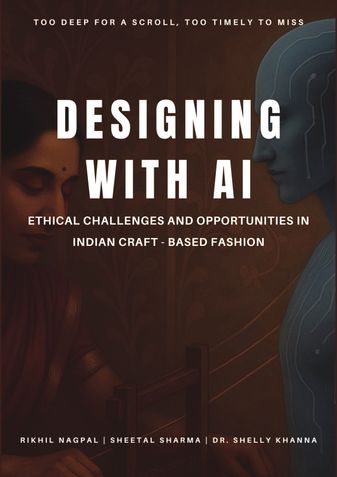
Designing with AI: Ethical Challenges and Opportunities in Indian Craft based Fashion

Rikhil Nagpal, Sheetal Sharma, Dr Shelly Khanna
Type: Print Book
Genre: Computers & Internet, Performing Arts
Language: English
Price: ₹3,998 + shipping
Dispatched in 10-12 business days.
Shipping Time Extra

Description

In an era where artificial intelligence is redefining every industry it touches, what does it mean to innovate in a way that honors heritage rather than erasing it?
Designing with AI: Ethical Challenges and Opportunities in Indian Craft-Based Fashion explores this pressing question through the lens of one of India’s most iconic textile traditions—the Maheshwari saree. Bridging centuries-old handloom wisdom with cutting-edge digital tools, this book invites readers into a conversation between artisans and algorithms, tradition and technology, ethics and evolution.

Author Rikhil Nagpal draws from immersive field research, surveys with weavers, designers, consumers, and policy makers, and the development of a custom AI language model—the Maheshwari Saree GPT—to craft a thoughtful, multi-dimensional exploration of how AI can participate in craft-based design without compromising its cultural soul.

With critical insight and cultural sensitivity, this book unpacks core concerns such as:

Authorship, ownership, and the risk of appropriation in machine-generated design

The socio-economic impact of AI tools on artisan livelihoods

Frameworks for ethical co-creation and digital storytelling

New possibilities in craft preservation, pedagogy, and design innovation

Perfect for designers, technologists, researchers, educators, and cultural advocates, this book is a timely invitation to rethink how we design with care in an increasingly automated world.

About the Authors

Rikhil Nagpal

Rikhil Nagpal is a fashion designer, educator, and researcher working at the intersection of craft heritage, digital innovation, and ethical design futures. With a background spanning industry practice and academic leadership, his work bridges traditional Indian textile cultures with contemporary technologies such as artificial intelligence, digital garment simulation (Clo3D), and design storytelling.

He has collaborated with artisans, design institutions, and policy stakeholders across India on projects that range from the revival of Maheshwari sarees to developing AI-based tools for craft co-creation. Known for his narrative-driven and systems-oriented approach, Rikhil's work challenges conventional binaries—between handmade and high-tech, past and future, art and algorithm.

He is a Design Evangelist at LWRN Studio, a platform dedicated to democratizing design education, and has authored books and courses that explore digital fashion, sustainable design, and cultural preservation. His research and teaching reflect a commitment to creating design ecosystems that are inclusive, innovative, and deeply human.

When he's not writing or teaching, you’ll find him documenting weaver stories, building GPTs for creative education, or rethinking the loom as a language of design.

Sheetal Sharma

A professional in Textile and Fashion Design with an urge to learn the emerging trends to set new horizon in Textile and Apparel Designing. I am, by Nature, curious about the fashion industry and its various endless opportunities to present myself. I get Inspired by people around me and I have expertise in fashion illustrations, development of textile patterns, Researching other artists and influencers in order to stay-up-to date with the latest movements. From the past years till now, I am learning new things everyday as a Fashion educator by studying and teaching the various aspects of Fashion Industry.

Dr Shelly Khanna

Dr. Shelly Khanna, the luminary Associate Professor spearheading the Faculty of Design at Dada Lakhmi Chand State University of Performing & Visual Arts in Rohtak, stands as a beacon of wisdom and expertise in the realm of Textiles & Apparel Industry. With a profound commitment to student-centered pedagogy, she crafts transformative strategies nurturing the growth of her disciples.

A venerable figure in the domain of Textile Technology, Dr. Khanna boasts a venerable career spanning two decades, crowned with a Doctorate from the esteemed National Institute of Technology, Jalandhar. Her scholarly pursuits span a diverse array of research endeavors.

Her academic legacy shines brightly through twenty research publications in esteemed national and international journals. Dr. Khanna's intellectual footprint extends to twenty seven Faculty Development Programs (FDPs), nineteen seminars & workshops, and twenty nine conferences, alongside six scholarly chapters in prestigious volumes.

In her current role as an Associate Professor at DLCSUPVA, Rohtak, Dr. Khanna has meticulously crafted and enhanced numerous courses, delving into subjects such as Traditional Indian Embroideries & Textiles, Automation in Garment Industry, and Computer-Aided Designing of Apparel Entities. A guiding light for undergraduate and postgraduate research projects, she actively spearheads students' industrial training, projects, and placements.

Dr. Khanna's research tapestry is woven with threads of innovation, focusing on avant-garde textile finishing techniques, sustainable textile processes, and the integration of smart textiles in healthcare and fashion realms. Noteworthy among her scholarly works are publications on aromatic and antibacterial finishes, mosquito-repellent textiles, and the mechanical properties of sewing threads.

A paragon of dedication and proficiency in the realm of education, Dr. Khanna stands tall as a stalwart bridging the realms of theoretical knowledge and practical advancements in the domain of textile technology.

Kapil Madhukar

Kapil Madhukar is a respected craft revivalist, design educator, and cultural advocate whose work bridges traditional textile heritage with contemporary design education. With decades of experience working alongside artisans, institutions, and policymakers, he has played a pivotal role in preserving India’s rich handloom traditions while nurturing new generations of socially conscious designers.

A mentor to many and a voice of quiet authority in the field, Mr. Madhukar’s perspective brings depth, sensitivity, and wisdom to this volume. His Foreword offers not just context, but a compass—for understanding how craft and technology might co-exist, not as competitors, but as collaborators.

LWRN Studio

Learn. Work. Rise. Nurture.

LWRN Studio is not just a creative platform—it’s a philosophy woven into a movement. The studio was born from a question: Can design education become a bridge between forgotten art / craft and futuristic labs? At LWRN Studio, the answer is a resounding yes.

Headquartered in India yet resonating globally, LWRN stands for Learn, Work, Rise & Nurture—four pillars that form the foundation of a new-age design ecosystem. The studio brings together artisans, students, technologists, and storytellers to co-create resources, rethink craft education, and shape ethical, culturally rooted design futures.

Whether it’s through:

MOOCs that teach AI to respect handwoven traditions,

Books that reimagine the loom as a language of design,

Or custom GPT tools that allow artisans and designers to co-create across geographies,

LWRN Studio is dedicated to crafting content that is deeply local yet globally relevant.

At the heart of LWRN is a commitment to democratizing design education—making it accessible to rural artisans as well as urban creators, to classrooms and clusters, to libraries and looms. It stands at the convergence of heritage and technology, intuition and innovation, art and algorithm.

LWRN Studio has collaborated with government bodies, cultural ministries, educational institutions, and independent creators to build a body of work that is both scholarly and soulful. Its output ranges from sustainable fashion documentation, digital craft curriculums, and heritage-inspired AI models, to hands-on tools that make complex ideas beautifully teachable.

This is not a studio that designs just for the moment—it designs for continuity, for context, and for community.

Because at LWRN, we believe the future of design isn't just smart.

It’s storied, sensitive, and shared.

Book Details

ISBN: 9788197379727
Publisher: LWRN Studio
Number of Pages: 192
Dimensions: 8.27"x11.69"
Interior Pages: Full Color
Binding: Hard Cover (Case Binding)
Availability: In Stock (Print on Demand)

Ratings & Reviews

Designing with AI: Ethical Challenges and Opportunities in Indian Craft based Fashion

Designing with AI: Ethical Challenges and Opportunities in Indian Craft based Fashion

(Not Available)

Review This Book

Write your thoughts about this book.

Currently there are no reviews available for this book.

Be the first one to write a review for the book Designing with AI: Ethical Challenges and Opportunities in Indian Craft based Fashion.

Other Books in Computers & Internet, Performing Arts

Shop with confidence

Safe and secured checkout, payments powered by Razorpay. Pay with Credit/Debit Cards, Net Banking, Wallets, UPI or via bank account transfer and Cheque/DD. Payment Option FAQs.