You can access the distribution details by navigating to My Print Books(POD) > Distribution
Add a Review
This book ships within India only.
Description
Introduction: The Quiet Revolution of “Almost”
Some books scream their existence. They announce themselves with thunder, with characters larger than life, with plots designed to dazzle. Ashes of Almost is not one of those books. It does not shout; it whispers. It does not chase drama; it lingers in silence. And yet, in that silence lies its most radical strength.
Shradhesh Kumar, with delicate precision, crafts a narrative that is less about what happens in the classroom and more about what is felt in the spaces around it. This is not the story of grades or achievements, not even of rebellion against authority. Instead, it is a meditation on invisibility, fragility, and the strange beauty of being “almost.”
The word almost carries weight here. Almost seen. Almost loved. Almost heard. Almost understood. The book acknowledges that human life is made of these fragments—moments that stop short of completion, connections that flicker but never ignite fully, hopes that fall just shy of fulfillment. In these “almosts” lie the ashes we carry: the quiet remains of what could have been. But in Shradhesh’s telling, those ashes are not lifeless. They are fertile. They whisper lessons of presence, resilience, and the subtle dignity of carrying unfinished stories.
The Story as Seed and Symbol
At the surface level, the book follows Ravi, a boy defined by his silence. He is not the noisy, troublemaking student who commands attention; nor is he the star achiever whose brilliance earns admiration. He simply is. In fact, for most of his peers and teachers, he almost isn’t. He exists in the shadow-space between recognition and invisibility. He is “there” but not fully seen, “present” but not fully felt.
The arrival of Ravina—a girl who chooses to sit beside him, not out of compulsion but out of choice—becomes the axis on which Ravi’s quiet world begins to shift. Their relationship is not fireworks. It is not even defined. It is presence. Shared silence. Sketches and diary notes passed like secret offerings. And through this presence, Ravi begins to feel something he has long been denied: that his existence matters.
But the story is not a fairytale. Ravina does not “save” Ravi. There is no dramatic transformation, no sudden leap into confidence and popularity. Instead, what unfolds is subtler, more truthful. She becomes a window—a crack through which light filters. Eventually, even when she fades, what remains with Ravi is not loss but the beginning of self-acceptance. He learns not only to be seen, but to see himself.
This, in essence, is the seed of Ashes of Almost: that the true revolution is not loud. It is quiet. It does not always take the form of victory; sometimes it takes the form of endurance.
Themes: The Ashes We Carry
Silence as Identity
Silence is not presented here as emptiness but as a language. Ravi’s silence is not weakness; it is carefulness, a shield, and eventually a presence. Through him, the novel interrogates our assumptions about introversion, about “quiet” students, about those who do not conform to the performative norms of classrooms.
Invisibility and the Hunger to be Seen
One of the sharpest aches in the book is Ravi’s invisibility. He is not bullied; he is not hated. He is simply overlooked, and in many ways, that is a deeper wound. The novel positions invisibility as a modern epidemic—how many students pass through schools unnoticed, their brilliance confined to secret notebooks, their worth unacknowledged because they do not demand attention?
The Poetics of “Almost”
The word “almost” recurs like a ghost throughout the narrative. It is both tragedy and tenderness. To almost succeed, almost connect, almost belong—these are the fragments most of us carry. Shradhesh transforms these fragments into ashes, not to mourn them, but to show their lingering warmth. “Almost” is not failure; it is a different kind of memory.
Presence as Love
In a world obsessed with definitions—friendship, romance, labels—the bond between Ravi and Ravina refuses to be named. It is neither dramatic romance nor platonic companionship. It is simply presence. The radical act of sitting beside someone, of choosing them in silence, of showing up consistently. The book elevates presence itself as an act of love.
Resilience Through Fragility
What makes Ashes of Almost moving is that it does not glorify strength in its conventional sense. Ravi does not become a hero, nor does he conquer his environment. His triumph lies in a smaller, quieter form: the ability to exist as himself, without apology. The resilience he discovers is not about becoming louder, but about accepting that his softness is also strength.
A Style That Mirrors Substance
Shradhesh Kumar’s prose mirrors the subject it carries. The writing is careful, deliberate, rhythmic like diary entries. It does not hurry. Scenes linger in pauses, in the way a character looks out a window, in the way a crow perches on a tree. Dialogue is minimal, but when it comes, it resonates. The structure of the book itself resembles Ravi’s presence: quiet, almost invisible at first, but unforgettable once noticed.
The use of diary entries—Ravi’s private reflections—becomes the heart of the text. These fragments blur the line between poetry and prose, between narrative and confession. They remind us that the deepest stories are often the ones never spoken aloud.
Why This Book Matters
At its core, Ashes of Almost speaks to an overlooked truth: that classrooms, despite being the center of learning, often fail to teach the most important lessons of existence. They measure intelligence, but not presence. They reward performance, but not authenticity. They notice the loud, but rarely the quiet.
For readers—especially students, teachers, and parents—this book is both mirror and challenge. It forces us to ask: Who are the Ravis we have overlooked? What poems have gone unread in the margins of a student’s notebook? What sketches have been lost in the corners of ruled pages? What does it mean to “educate” if we fail to notice the silent ones?
But beyond critique, the book is also a balm. It assures the quiet reader, the invisible student, the overlooked dreamer: your presence matters, even if unacknowledged. Your silence is not absence. You are part of the story, even if the world does not name you.
Conclusion: From Ashes to Open Sky
Ashes of Almost is not about closure. It is about continuation. It leaves readers not with a neatly tied ending, but with a quiet invitation: to honor their own “almosts.” To see beauty in unfinished stories. To recognize that silence is not the absence of sound, but the presence of listening.
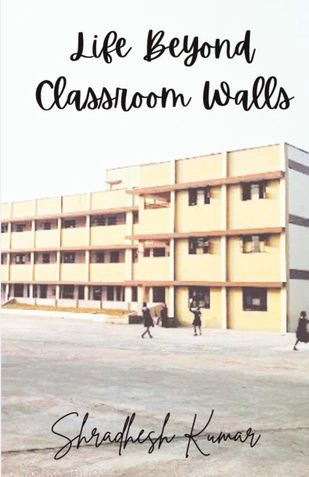
This is only Part 1 of the Life Beyond Classroom Walls series, but it already establishes Shradhesh Kumar as a writer unafraid of gentleness. In an age of noise, his book dares to whisper. And in that whisper, it reaches directly into the reader’s own unspoken places.
To read Ashes of Almost is to rediscover yourself—not in the moments of triumph, but in the fragile ashes of what you almost were, almost had, almost became. And perhaps that is the greatest lesson of all.
About the Author
Book Details
Publisher: Shradhesh kumar
Number of Pages: 637
Dimensions: 5.5"x8.5"
Interior Pages: B&W
Binding:
Paperback (Perfect Binding)
Availability:
In Stock (Print on Demand)
Ratings & Reviews
Life Beyond Classroom Walls
Review This Book
Write your thoughts about this book.

Currently there are no reviews available for this book.
Be the first one to write a review for the book Life Beyond Classroom Walls.
Other Books in Teens

Devanshu Gupta

Saatvikk Neil Mishra

Katrina Kahler

Katrina Kahler