You can access the distribution details by navigating to My Print Books(POD) > Distribution

Add a Review
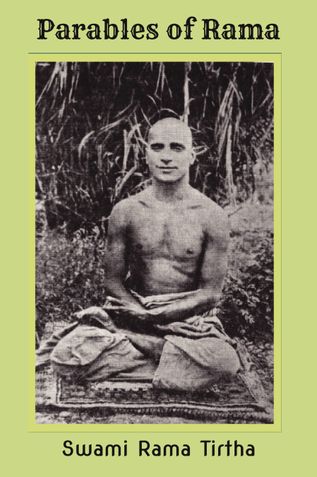
Parables of Rama by Swami Rama Tirtha

(The Sacred Stories narrated by Swami Rama Tirtha, to convey the Eternal Wisdom of Vedanta)
Swami Rama Tirtha
Type: Print Book
Genre: Philosophy, Religion & Spirituality
Language: English
Price: ₹963

Price: ₹963
Free Shipping
Dispatched in 5-7 business days.
Shipping Time Extra

Description

The sacred stories shared by Swami Rama Tirtha, through which he gently unveils the timeless wisdom of Vedanta. Each story holds a Deep Spiritual meaning that we can bring into our thoughts, actions, and daily life.

MORAL: Ignorance or darkness can be removed by Gyana, or knowledge of the Self and not by penances, fasting or other ceremonies.

MORAL: Everybody reaps the fruit of his own desires. This is the Law of Karma.

MORAL: The real poverty does not consist in want of riches but in an unsatiated want or greed for more and more.

MORAL: The true neighbour is not he who lives in the same house with you but that who lives on the same plane of thought with you.

MORAL: Everything looking however insignificant, is important and useful in its own place, and hence indispensable.

MORAL: A Realised Soul is above all attractions of Heaven or fears of Hell, for he himself is all.

MORAL: Searching for pleasure in the worldly objects is vain. The Home of Bliss is within you.

MORAL: By our own imagination you make things attractive and then run after them.

MORAL: Ignorance of Reality is the Cause of all Jealousy and Fear.

MORAL:—People rejoice in caring for the body, while they have lost the soul, or Self. This is ridiculous and foolish.

About the Author

Swami Rama Tirtha (22 October 1873 – 17 October 1906), also known as Ram Soami, was a radiant teacher of the eternal Hindu philosophy of Vedanta. He was among the first illumined masters of India to carry the light of Vedanta to the West, travelling to the United States in 1902. He followed the footsteps of Swami Vivekananda (1893) and preceded Paramahansa Yogananda (1920). During his American tours, Swami Rama Tirtha spoke with great fervor on the living ideal of Practical Vedanta and on the spiritual and intellectual awakening of Indian youth. With a vision that blended wisdom with compassion, he proposed that young Indians be educated in American universities, and he helped establish scholarships for their upliftment.

Biography :-

Rama Tirtha was born in a Gosvami Brahmin family to Pandit Hiranand Goswami on 22 October 1873 (Deepawali, Vikram Samvat 1930) in the village of Muraliwala in Gujranwala District of Punjab (now in Pakistan). His mother passed away when he was only a few days old, and he was lovingly raised by his elder brother Gossain Gurudas.

Gifted with a brilliant intellect, Rama Tirtha obtained a master’s degree in mathematics from The Government College of Lahore and became a professor at Forman Christian College, Lahore.

In 1897, a destined meeting with Swami Vivekananda in Lahore awakened the call of renunciation in him. Known for his inspired discourses on Sri Krishna and Advaita Vedanta, he embraced the life of a sannyasi on Deepawali of 1899, leaving behind his wife, children, and academic position to walk the path of divine service.

“As a sannyasi, he neither touched money nor carried luggage with him. In spite of this, he went around the world.” His journey to Japan, sponsored by Maharaja Kirtishah Bahadur of Tehri, marked the beginning of his world mission. From Japan he sailed to the United States in 1902, where for two years he poured forth his message of Vedanta, universal brotherhood, and spiritual freedom.

He boldly spoke against the rigidities of caste, emphasized the sanctity of women’s education, and upliftment of the poor, declaring: “Neglecting the education of women, children, and the laboring classes is like striking a death-blow to the very roots of the tree of nationality.” His heart burned with the conviction that India needed enlightened youth, not missionaries. To this end, he founded organizations for Indian students in American universities and worked to secure scholarships for their learning.

In a true spirit of humility and detachment, he always referred to himself in the third person — a spiritual discipline practiced to dissolve the ego.

Though his return to India in 1904 was greeted with overflowing crowds, by 1906 he withdrew from all public activity and retired to the Himalayan foothills to prepare a systematic work on Practical Vedanta. On 17 October 1906 (Deepawali, Vikram Samvat 1963), he cast off the mortal frame. Many devotees believe he did not die but merged his body into the sacred flow of the river Ganges.

He left behind a divine prophecy for India: “After Japan, China will rise and gain prosperity and strength. After China, the sun of prosperity and learning will again smile at India.”

Legacy :-

The glory of Swami Rama Tirtha’s life shines far beyond his brief years on earth. His soul-stirring presence was remembered by revolutionaries like Bhagat Singh, who cited him as a beacon of Punjab’s contribution to the freedom movement. Pandit Ram Prasad Bismil celebrated him in his poem Yuva Sannyasi.

Two of his disciples, S. Puran Singh and Narayana Swami, chronicled his life. Puran Singh’s The Story of Swami Rama: The Poet Monk of the Punjab (1924) was published in English and Hindi, while Narayana Swami contributed an account to his collected works (1935). Later, Hari Prasad Shastri published Scientist and Mahatma (1955), including poems of Swamiji translated by H. P. Shastri.

Paramhansa Yogananda also honored his memory by translating many of Rama Tirtha’s inspired poems into English and even setting some to Cosmic Chants. One of them, Marching Light, was published in Cosmic Chants as “Swami Rama Tirtha’s Song.”

The Swami Rama Tirtha Mission Ashram stands at Kotal Gaon Rajpura near Dehradun, and the Swami Rama Tirtha Parisar of Hemwati Nandan Bahuguna Garhwal University in New Tehri is named in his memory.

His divine influence continued through his family line: his nephew H. W. L. Poonja (“Papaji”) became a renowned Advaita master in Lucknow, and his great-grandson Hemant Goswami is known as a social activist in Chandigarh.

Swami Rama Tirtha remains a blazing flame of renunciation, wisdom, and universal love — a poet-monk who carried the eternal voice of Vedanta across oceans and whose life itself was a living scripture.

Book Details

ISBN: 9798895416907
Number of Pages: 628
Dimensions: 6"x9"
Interior Pages: B&W
Binding: Paperback (Perfect Binding)
Availability: In Stock (Print on Demand)

Ratings & Reviews

Parables of Rama by Swami Rama Tirtha

Parables of Rama by Swami Rama Tirtha

(Not Available)

Review This Book

Write your thoughts about this book.

Currently there are no reviews available for this book.

Be the first one to write a review for the book Parables of Rama by Swami Rama Tirtha.

Other Books in Philosophy, Religion & Spirituality
Shop with confidence

Safe and secured checkout, payments powered by Razorpay. Pay with Credit/Debit Cards, Net Banking, Wallets, UPI or via bank account transfer and Cheque/DD. Payment Option FAQs.