You can access the distribution details by navigating to My Print Books(POD) > Distribution
Add a Review
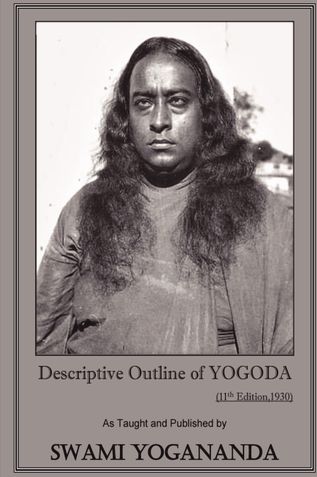
Descriptive Outline of YOGODA (11th Edition,1930)
[A Method of Recharging the Body, Mind and Soul Batteries from Inner Cosmic Energy]
Swami YoganandaType:
Print Book
Genre: Religion & Spirituality, Antiques & Collectibles
Language: English
Price:
₹252
+ shipping
Description
"This book is an exact replica of the Original 11th Edition, published by Swami Yogananda in 1930."
"DO NOT ACCEPT BLINDLY WHAT I SAY; PRACTICE AND PROVE FOR YOURSELVES FROM YOUR OWNEXPERIENCE."
— Paramhansa Yogananda (From The Flawless Mirror, Kamala Silva book, page no.15)
HISTORY OF THE “YOGODA SAT-SANGA SOCIETY” IN INDIA AND AMERICA :-
“Yogoda" is the name of a system for harmonious and full development of, body, mind and soul, which has been brought to America by Swami Yogananda of India. This “Yogoda” System is made up of two distinct parts — one part the basic principle of which is the discovery of Swami Yogananda, and the other part the contribution of the ancient sages of India, adapted by Swami Yogananda for the use of Western peoples. When Swami Yogananda first made the great discovery of how the individual supply of energy could be connected with the unlimited storehouse of inner cosmic energy, he realized that the right application of this knowledge could overcome the physical handicap of ill-health which has ever been one of the chief obstacles to man’s progress throughout the ages. But man is more than a body. To be in a state of perfect physical health does not constitute happiness, nor does it fulfill the purposes of man’s destiny. Man’s nature is three-fold. Swami Yogananda therefore felt that any system which could rightly consider itself of universal and all-round use and application must include methods whereby man could perfect himself in all his varied manifestations — physical, mental and spiritual.
To his own discovery of a method for physical wellbeing, Swami Yogananda therefore added a scientific technique of concentration and meditation for mental and spiritual power — a technique which has been used in India for several thousand years by saints and sages, and now incorporated by Swami Yogananda into his “Yogoda" Course in a simple, practical form especially adapted to the requirements and environment of the busy but aspiring Western peoples. Swami Yogananda belongs to the “Sat-Sanga Order" in India. “Sat-Sanga” means "fellowship with truth," and this organization has as one of its principal aims the establishment of international good-will, understanding and fellowship. Swami Yogananda brings the ideals of this Sat-Sanga Order to America, and calls his educational, non-sectarian message by the name of “Yogoda Sat-Sanga." Swami Yogananda received his title of “Swami” from his Great Master, Swami Sriyukteswar Giriji Maharaj of Bengal, who is still living in India. (The title “Swami,” meaning “Master,” one who aims to master himself, can only be bestowed on a qualified disciple by one who is himself a Swami, tracing his title through the line of successive Swamis back to the 7th century, A.D., when the great sage and saint, Lord Shankaracharya, reorganized the ancient Order of Swamis in India.)
The first school to teach the methods of Yogoda was founded by Swami Yogananda in India, at Ranchi, Bengal. Later two more schools were started at Puri and Bankura, Bengal. All are Residential Schools for boys. Recently a branch of the Ranchi School was opened at Purulia, where 10,000 people attended the opening ceremonies. The Ranchi School had as its patron the Maharajah of Kasimbazar, Sir Manindra Chandra Nundy, Member of the Imperial Council, Government of India, and one of the most progressive and benevolent princes of India, who gave one of his palaces for the use of the school. From a small beginning with seven pupils, the Ranchi School has grown to be a large and flourishing institution, with capacity for three hundred. So great has been the demand for admission into this institution from all parts of India that at the end of its first year there were about 2,000 applicants for admission. These Residential Schools have achieved in India a very enviable reputation for all-round education. Some of the teachers and students of the Ranchi School are pictured in this booklet.
In the Ranchi School, Swami Yogananda conducted the first experiments with his new system. The results were nothing short of astonishing. Children under ten years of age gained remarkable physical and mental strength. They developed extraordinary ability to shift the life energy from one part of the body to another part, and performed feats of strength and endurance that many adults could not equal. They were trained to sit in perfect poise in difficult body-postures.
During the concentration tests, twelve year old boys demonstrated their ability to sit three or more hours motionless, in deep concentration or meditation. Their training also enabled them to carry out the active works of their life without fatigue. Besides the unique training of Yogoda, the boys of these three Indian schools also receive regular grammar school and high school education, including academic, agricultural, industrial and commercial training. Swami Yogananda came to America in 1920 as the delegate from India to the International Congress of Religious Liberals in Boston, Mass. The Boston people were very much interested in the message of the Swami, and as a result, the first Yogoda Sat-Sanga Center in America was organized in Boston. The Boston work grew rapidly. Swami Yogananda found it necessary to send for a co-worker in India, who took charge of the Boston Center.
About the Author
Book Details
Publisher: Swami Yogananda
Number of Pages: 100
Dimensions: 6"x9"
Interior Pages: B&W
Binding:
Paperback (Perfect Binding)
Availability:
In Stock (Print on Demand)
Ratings & Reviews
Descriptive Outline of YOGODA (11th Edition,1930)
Review This Book
Write your thoughts about this book.

Currently there are no reviews available for this book.
Be the first one to write a review for the book Descriptive Outline of YOGODA (11th Edition,1930).
Other Books in Religion & Spirituality, Antiques & Collectibles
Abhishek Tondon

GAGNA SETHI
NIVEDITA N
Ajai Kumar Chhawchharia