A Child of the Stars: Early Passion for Physics
From the earliest moments of his childhood, Adarsh Kanojia showed an unmistakable fascination with the cosmos. At an age when most children are just beginning to grasp the world around them, Adarsh was already reaching beyond it. His questions—“Why does time move only forward?”, “How can something exist inside a black hole?”—were not the musings of idle curiosity, but reflections of a mind uniquely attuned to the mechanics of reality.
Born with an insatiable desire to understand the workings of the universe, Adarsh found his compass in science, particularly physics. By the time he was in middle school, he had surpassed standard curriculums, immersing himself in subjects often reserved for advanced undergraduates—relativity, quantum field theory, and even speculative frameworks like string theory and M-theory. Physics wasn’t just his subject; it was his second language.
His teachers quickly noticed. Mentors and educators described him as “decades ahead in comprehension,” “unnervingly focused,” and “a quiet storm of genius.” But what set him apart was not only his intellectual firepower, but his ability to communicate those ideas to others—making the complex feel touchable, the abstract beautiful.
Recognition and Achievement: ISO Topper at 13
Adarsh’s brilliance didn’t go unnoticed in academic competitions. At just 13 years old, he achieved national distinction as a Topper in the International Science Olympiad (ISO) under the prestigious Silverzone Foundation. Competing against thousands of students from across India and abroad, Adarsh demonstrated not only depth of understanding but also precision, speed, and conceptual mastery.
The ISO award was more than a trophy—it was a signal. A young mind not only engaged with the universe’s laws, but shaping the way others could see and understand them. It also gave Adarsh the confidence and platform to begin a larger journey—one not just of academic excellence, but of storytelling and scientific communication.
Mastering Advanced Physics: Beyond the Textbooks
Where most students his age might stop at Newtonian mechanics or simple optics, Adarsh ventured further. He routinely solved problems in:
Special and General Relativity
Schwarzschild geometry and black hole metrics
Quantum Mechanics and Wave-Particle Duality
Thermodynamics and Statistical Mechanics
Quantum Tunneling and Probabilistic Causality
Theoretical Cosmology and Dark Energy Modeling
His personal notes—composed in crisp, diagram-rich pages—resembled the notebooks of advanced graduate students. More importantly, he used these tools not to chase grades but to answer real questions: “What lies beyond the event horizon?” “Can a wormhole be traversed?” “Is time emergent or fundamental?”
Such inquiries weren’t abstract puzzles to him—they were stepping stones in a journey of cosmic truth-seeking.
A Storyteller of the Stars
Adarsh’s strength lies not only in his command of equations but in his extraordinary capacity for expression. He doesn’t simply calculate; he explains. With a prose style reminiscent of Carl Sagan, Brian Greene, and Brian Cox, Adarsh humanizes the abstract.
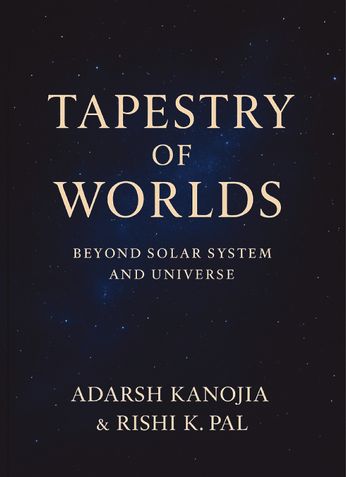
In Tapestry of Worlds, his voice is the one that asks, “What does it feel like to fall into a black hole?” and “Could consciousness arise from cosmic order?” He writes not to teach but to share the awe of discovery. He believes, passionately, that knowledge loses its value if it is not shared.
His ability to weave hard science with poetic clarity makes his work stand out among youth-authored nonfiction. And it’s not just theoretical. Adarsh has delivered talks at school symposiums, been invited to local science forums, and contributed articles to online science platforms aimed at young learners.
The Future of Physics – and a Philosopher at Heart
Despite his accolades and achievements, Adarsh is grounded and driven not by ambition but by curiosity. When asked what he wants to become, he doesn’t say “scientist” or “physicist.” He says:
“I want to understand why the universe allows itself to be understood.”
That humility, wrapped in intellectual audacity, is what defines him.
Whether he becomes a theoretical physicist, a researcher, an author, or all of the above, Adarsh’s trajectory is set—not because he knows where he’s going, but because he is guided by the oldest navigation system of all: wonder.
Excellent Book
Very good space book! This book teaches me very thing about our solar system and universe!!!