You can access the distribution details by navigating to My Print Books(POD) > Distribution
Add a Review
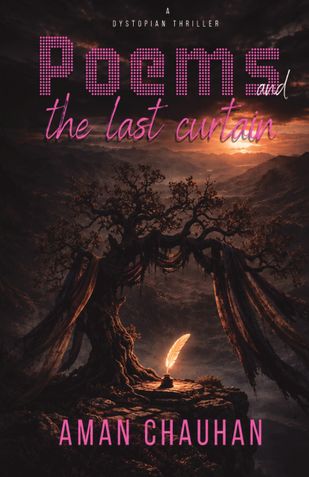
Type:
Print Book
Genre: Science Fiction & Fantasy
Language: English
Price:
₹550
+ shipping
This book ships within India only.
Description
What if, in a world where even water is rationed, the most dangerous thing you could possess was a voice?
In a drought-stricken future where water arrives by convoy and every litre is counted, the Council has built a society around scarcity, obedience, and silence. Beyond the walls of the privileged Jal communities, settlements like Rekhat survive on ration cards, empty tanks, and the constant fear of the Sukha Patrol.
Kabir Rehan Ashford has learned what that silence costs.
After his mother is killed at a water line, Kabir does not reach for a weapon. He reaches for a pen.
His first poem is six lines chalked onto a water-tank wall before dawn. The Council scrubs it away within hours, but not before the words have been read, remembered, and carried from one thirsty settlement to another.
Soon, the poems become known as the Dust Verses.
And the poet becomes a problem the Council cannot simply erase.
Hundreds of kilometres away, Ira Noor Whitfield lives behind a different kind of wall. Surrounded by gardens that are allowed to remain green while the world outside counts its thirst, she has been raised to mistake comfort for freedom. An arranged marriage waits for her, along with the carefully controlled life her family believes she should be grateful for.
Then she finds Kabir's poem hidden inside a ration card.
For the first time, Ira encounters a truth that her world has spent years teaching her not to see.
Their paths eventually cross, bringing together two people from opposite sides of the same divided society. What begins with a poem becomes something far larger: a network of ordinary people who print, teach, carry, hide, remember, and speak, each understanding that resistance is rarely one grand act, but thousands of small acts performed by people who refuse to surrender their humanity.
But the Council is watching.
And Commissioner Alaric Devraj Sen, a man who once wrote poetry himself, understands perhaps better than anyone why words can become more dangerous than weapons.
Poems and the Last Curtain is a story about drought and power, but also about grief, love, literacy, memory, and the stubborn human need to tell the truth.
It asks:
What survives when a regime controls what you can drink, what you can read, and what you are allowed to say?
Sometimes it is a poem.
Sometimes it is a name.
Sometimes it is a person brave enough to speak.
And sometimes, when the first voice falls silent, someone else picks up the pen.
This was never the last curtain.
About the Author
Book Details
Number of Pages: 282
Dimensions: 5.51"x8.50"
Interior Pages: B&W
Binding:
Paperback (Perfect Binding)
Availability:
In Stock (Print on Demand)
Ratings & Reviews
Poems and The Last Curtain
Review This Book
Write your thoughts about this book.

Currently there are no reviews available for this book.
Be the first one to write a review for the book Poems and The Last Curtain.
Other Books in Science Fiction & Fantasy
M.A.B. Veyne
N.M Thota
Jivan
Parigyan