You can access the distribution details by navigating to My Print Books(POD) > Distribution
Add a Review
Description
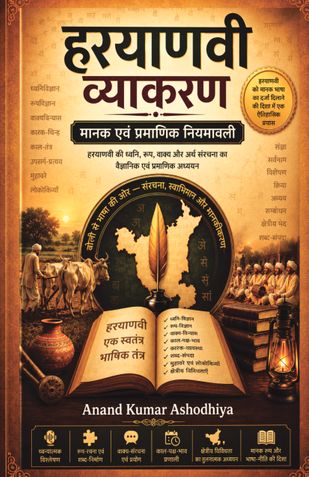
हरयाणवी व्याकरण : मानक एवं प्रमाणिक नियमावली (Haryanvi Grammar: A Standard & Authentic Manual) is a comprehensive linguistic and sociolinguistic study dedicated to the grammatical structure, standardization, and expressive potential of the Haryanvi language. Written by Anand Kumar Ashodhiya, this pioneering work seeks to document, analyze, and present Haryanvi in a systematic and scholarly manner while highlighting its rich linguistic heritage and contemporary relevance.
The book examines the sound system, script conventions, word formation processes, grammatical categories, sentence structure, idiomatic expressions, and regional variations of Haryanvi. Drawing upon principles of linguistics, sociolinguistics, and language planning, it explores the historical development of Haryanvi and evaluates its capacity for standardization and wider functional use in education, literature, media, and public communication.
Special attention has been given to developing clear and authentic grammatical rules based on actual language usage, traditional oral heritage, folk literature, and contemporary linguistic evidence. The work also addresses key issues related to language identity, language preservation, and the distinction between “boli” (dialect) and “bhasha” (language) within the Indian linguistic context.
This volume serves as an essential resource for linguists, researchers, students, teachers, translators, writers, cultural historians, policy makers, and all those interested in the study and promotion of Haryanvi. By combining academic rigor with practical accessibility, the book contributes significantly to the ongoing discourse on regional languages, language standardization, and linguistic diversity in India.
Key Features:
• Comprehensive description of Haryanvi grammar and linguistic structure
• Analysis from linguistic, sociolinguistic, and language-standardization perspectives
• Coverage of phonology, morphology, syntax, and vocabulary formation
• Discussion of regional variation and standardization issues
• Useful for academic research, language teaching, and cultural documentation
• A significant contribution to the study and preservation of Haryanvi language and heritage
Whether you are a scholar, language enthusiast, or advocate of India's linguistic diversity, this book offers a valuable and authoritative guide to understanding the structure, richness, and future potential of Haryanvi.
About the Author
Book Details
ISBN: 9789359164939
Publisher: Anand Kumar Ashodhiya
Number of Pages: 341
Dimensions: 5.5"x8.5"
Interior Pages: B&W
Binding:
Paperback (Perfect Binding)
Availability:
In Stock (Print on Demand)
Ratings & Reviews
हरयाणवी व्याकरण : मानक एवं प्रमाणिक नियमावली
Review This Book
Write your thoughts about this book.

Currently there are no reviews available for this book.
Be the first one to write a review for the book हरयाणवी व्याकरण : मानक एवं प्रमाणिक नियमावली.
Other Books in Education & Language
Dr. Anuj Kumar Sinha
Shriya Vohra, Dr. Pina Bhatt
s gopalan
Atharva Publication