You can access the distribution details by navigating to My Print Books(POD) > Distribution
Add a Review

Basics of LaTeX for Students
Prashant Kulkarni
DBMS Made Easy
Narendra babu
Piping Welder Handbook
Ram Babu Sao
Electronics For You, February 2013
EFY Enterprises Pvt Ltd
This book ships within India only.
 Free Shipping
Description
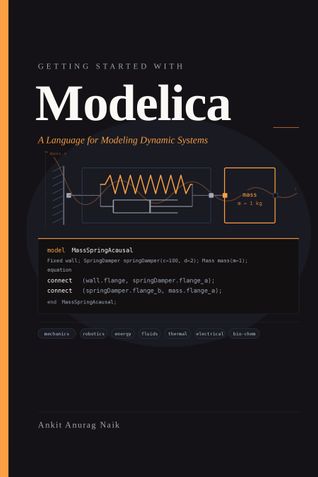
Modelica is the language engineers reach for when a system crosses domain boundaries — when the same model must capture electrical, thermal, mechanical, and fluid behavior at once. This book builds the language from scratch, the way a tutor would.
Getting Started with Modelica is structured as a guided progression. Each chapter adds one idea. Every concept is grounded in code you write yourself. Nothing is assumed from the previous page that wasn't taught on it. By the end, you can read existing models, write new ones, diagnose problems, and know where to look when something does not behave as expected.
No prior Modelica experience required. Basic familiarity with differential equations and engineering systems is assumed.
What you will learn:
Why acausal, equation-based modeling changes what engineers can express
How to build and simulate models using the Modelica Standard Library
How to write textual models from scratch
Arrays, for loops, events, and hybrid models
Inheritance, records, and replaceable components
Functions, enumerations, inner/outer, and assert
How to feed data in and get results out
What the compiler actually does — and how to read the equation browser when a simulation fails
Solvers, stiffness, and FMI
Chapter 15 makes a concrete argument: Modelica is the language best suited for LLM-assisted engineering. The compiler checks structural correctness, conservation laws are automatic, and the open standard means any engineer can validate the output.
Each chapter ends with a summary and a hands-on exercise. 276 pages.
A note on tools: All workflows and examples use Wolfram System Modeler. The language concepts apply to any compliant tool, but this book does not cover other Modelica environments. A 30-day free trial is available from Wolfram Research.
About the Author
Book Details
ISBN: 9789199160825
Publisher: Ankit Anurag Naik
Number of Pages: 276
Dimensions: 6"x9"
Interior Pages: B&W
Binding:
Paperback (Perfect Binding)
Availability:
In Stock (Print on Demand)
Ratings & Reviews
Getting Started with Modelica
Review This Book
Write your thoughts about this book.
Currently there are no reviews available for this book.
Be the first one to write a review for the book Getting Started with Modelica.
Other Books in Engineering
Prashant Kulkarni

Narendra babu

Ram Babu Sao

EFY Enterprises Pvt Ltd