You can access the distribution details by navigating to My Print Books(POD) > Distribution
Add a Review
Type:
Print Book
Genre: Engineering, Job & Career
Language: English
Price:
₹399
+ shipping
This book ships within India only.
Description
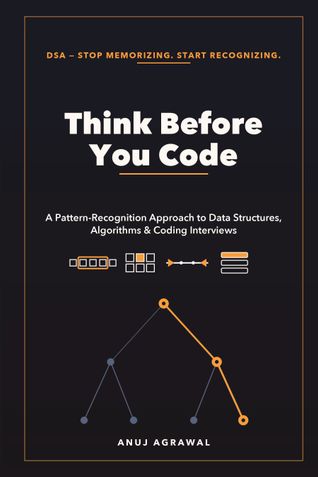
You studied the algorithms. You solved a hundred problems. Then the interviewer hands you one you have never seen, and your mind goes blank.
That freeze is not a knowledge gap. It is a recognition gap — and almost no one trains it.
Most interview prep teaches you to memorize solutions to labeled problems. You practice the sliding window chapter, so every problem in front of you is a sliding window problem. The label is handed to you. But a real interview quietly removes the label. It describes a delivery route, a stream of numbers, a game board — and your job is to decide, alone, which pattern it belongs to. That is a different skill from solving, and it is the one this book trains.
Think Before You Code is built around a three-question diagnosis you run before writing a single line: which pattern is this, why, and what is the one guiding question that cracks it open. Each chapter builds a pattern from its fundamentals, walks through a problem the way an experienced engineer actually thinks out loud, then gives you a graded ladder of practice problems with the label hidden — so you train recognition instead of recall.
Inside, you will find:
Every core pattern that shows up in technical interviews — sliding window, two pointers, hashing, binary search, trees and graphs, backtracking, dynamic programming, greedy, intervals, and more
A repeatable diagnosis method for reading an unfamiliar prompt and naming its pattern before you code
Practice ladders with the pattern hidden, so you rehearse the exact moment that breaks candidates in real interviews
A master decision tree tying every pattern together, plus mixed-diagnosis drills and full mock walkthroughs
The interviewer's-eye view: what separates a candidate who freezes from one who calmly narrates their way to a solution, written by an engineering leader who has sat on both sides of the table
This is not another list of five hundred problems to memorize. It is the missing habit that turns everything you already know into an answer you can produce under pressure — the difference between a candidate who has studied and one who is actually ready.
If you have done the practice and still freeze on anything new, this book teaches you the one skill that fixes it: naming the problem before you solve it.
About the Author
Book Details
Number of Pages: 200
Dimensions: 6.00"x9.00"
Interior Pages: B&W
Binding:
Paperback (Perfect Binding)
Availability:
In Stock (Print on Demand)
Ratings & Reviews
Think Before You Code
Review This Book
Write your thoughts about this book.

Currently there are no reviews available for this book.
Be the first one to write a review for the book Think Before You Code.
Other Books in Engineering, Job & Career
Suman Sarkar

Prof. Subhash Jagtap

DR INDULEKHA R
![XVIth ISTE Maharashtra Goa Staff Convention National Conference on Recent Advances in Engineering & Technology [Proceedings] November 15th-16th, 2013](https://simg.pothi.com/ggw8XgIkXXojo1M65JrK5qT45RyjtzCUvb4dxw2U-L4/rs:fit/w:130/h:175/el:1/g:sm/cb:rev-6/bG9jYWw6Ly8vaW1h/Z2VzL3Byb2R1Y3Rz/LzIwMjIvMDcvU0tV/NDcwNC9JbWFnZV8w/LmpwZw.jpg)
Prof. G. M. Kadam (Editor), Prof. Tirupati Iltapawar ...