You can access the distribution details by navigating to My Print Books(POD) > Distribution
Add a Review
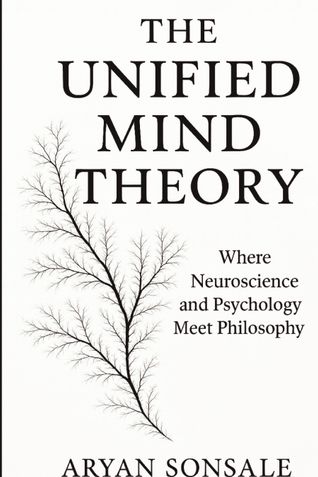
Description
What if the human mind could finally be understood as a single, unified system?
Unified Mind Theory presents a bold, integrative framework that brings together neuroscience, psychology, emotional architecture, symbolism, subconscious computation, and philosophy into one coherent model of how the mind forms, adapts, suffers, heals, and evolves.
Rather than treating cognition as a collection of isolated functions, this work argues that the mind operates as a layered, integrative system—shaped by emotional weighting, symbolic compression, subconscious simulation, and narrative identity. These layers are mapped with scientific clarity, philosophical depth, and structural precision.
Inside this book, readers will explore:
• How prenatal and early conditions shape cognitive architecture
• The subconscious as a real-time simulation engine
• Why dreams function as compressed informational reports, not randomness
• Emotion as a computational signal rather than a mere reaction
• Why intelligence emerges from integration, not raw ability
• How trauma, ADHD, OCD, and bipolar traits reflect architectural distortions
• How love, attachment, and heartbreak map onto predictive systems
• How identity forms, fractures, and reconstructs through symbolic layers
• How consciousness emerges from recursive integration
• How minds can be recalibrated through emotional, narrative, and symbolic restructuring
Unified Mind Theory bridges scientific insight and philosophical inquiry, offering a new lens on human experience—from creativity, intuition, and genius to suffering, healing, and transformation.
This is not simply a psychological model.
It is a structural map of meaning, consciousness, and the architecture of being human.
For readers interested in:
Neuroscience • Psychology • Philosophy of Mind • Cognitive Science • Symbolism • Emotional Theory • Interdisciplinary Thought • Personal Evolution
A comprehensive and original framework, this book invites researchers, thinkers, and seekers to approach the mind not as an unsolvable mystery—but as an elegant system continually integrating itself toward coherence.
Inside this book, readers will discover:
• How prenatal conditions shape cognitive architecture
• How the subconscious operates as a real-time simulation engine
• Why dreams are compressed reports rather than random images
• How emotions function as computational signals, not reactions
• Why intelligence emerges from integration rather than raw ability
• How trauma, ADHD, OCD, and bipolar traits reflect architectural distortions
• How love, connection, and heartbreak map onto predictive systems
• How identity forms, fractures, and reconstructs through symbolic and emotional layers
• How consciousness emerges from recursive integration
• How minds can be redesigned through emotional, narrative, and symbolic recalibration
Unified Mind Theory bridges scientific insight and philosophical inquiry, offering a new lens on human experience—from genius, creativity, and intuition to suffering, healing, and transformation.
This is not simply a psychological model—it is a structural map of existence, meaning, and the architecture of being human.
For readers of:
Neuroscience • Psychology • Philosophy of Mind • Cognitive Science • Symbolism • Emotional Theory • Personal Evolution • Interdisciplinary Thought
A bold and comprehensive framework, this book invites researchers, thinkers and seekers to understand the mind not as a mystery—but as an elegant, layered system continually integrating itself toward coherence.
About the Author
Book Details
Publisher: The Count
Number of Pages: 158
Dimensions: 6"x9"
Interior Pages: B&W
Binding:
Paperback (Perfect Binding)
Availability:
In Stock (Print on Demand)
Ratings & Reviews
The Unified Mind Theory
Review This Book
Write your thoughts about this book.

Currently there are no reviews available for this book.
Be the first one to write a review for the book The Unified Mind Theory.
Other Books in Medicine & Science

Pranav Kapadia

Desmond Gahan

Dr. Manoj Sharma

KAMBHAM VENKATESWARLU