You can access the distribution details by navigating to My Print Books(POD) > Distribution
Add a Review
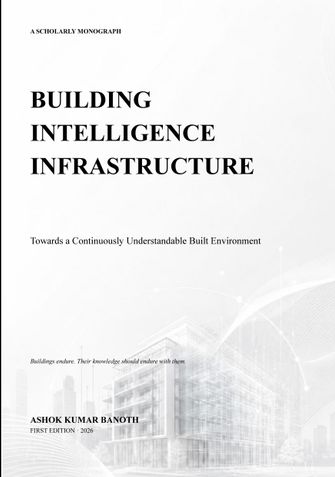
Building Intelligence Infrastructure
Towards a Continuously Understandable Built Environment
Ashok Kumar BanothType:
Print Book
Genre: Information Technology, Architecture
Language: English
Price:
₹599
+ shipping
This book ships within India only.
Description
Buildings are long-lived assets, yet the knowledge required to understand them is often fragmented across drawings, models, reports, databases, operational systems and institutional boundaries. As buildings change over time, the connection between the physical asset and the information that explains it can progressively weaken.
Building Intelligence Infrastructure: Towards a Continuously Understandable Built Environment develops a framework for addressing this problem through Building Intelligence Infrastructure (BII): a persistent knowledge layer intended to preserve, connect and govern building information across the lifecycle.
The book develops the concept of the Digital Building Identity (DBI) and examines how structured building knowledge can support continuity from design and construction through operation, finance, carbon assessment, retrofit and wider building-stock intelligence. It considers the roles of provenance, authority, interoperability, temporal continuity and human oversight, including their importance when artificial intelligence is introduced into building-related decision processes.
Rather than treating digitalisation as simply the accumulation of more data, the book asks a more fundamental question: how can the built environment remain continuously understandable as buildings, technologies, organisations and information systems change?
Written at the intersection of architecture, infrastructure, information systems and institutional decision-making, this book is intended for researchers, built-environment professionals, policymakers, financial institutions and others interested in the long-term intelligence infrastructure of buildings.
About the Author
Book Details
Publisher: Built Continuum Press
Number of Pages: 130
Dimensions: 5.82"x8.28"
Interior Pages: B&W
Binding:
Paperback (Perfect Binding)
Availability:
In Stock (Print on Demand)
Ratings & Reviews
Building Intelligence Infrastructure
Review This Book
Write your thoughts about this book.

Currently there are no reviews available for this book.
Be the first one to write a review for the book Building Intelligence Infrastructure.
Other Books in Information Technology, Architecture

Biswanath Parida


Shashikant Nishant Sharma