You can access the distribution details by navigating to My Print Books(POD) > Distribution
Add a Review
Type:
Print Book
Genre: Business & Economics, Computers & Internet
Language: English
Price:
₹241
+ shipping
This book ships within India only.
Description
Every profession has its moments.
A software engineer experiences a breakdown at a critical moment before a production run. A manager knows something feels wrong stepping into a boardroom, even if they can't characterize the cause. A teacher is at a loss when their best students are consistently under winners. An engineer has to choose the clear solution versus the ethical one.
At first glance, these situations appear unrelated. They aren't.
Over the last 40+ years in the fields of technology, engineering, and education, I have come to see a consistent reality: the most significant problems are not usually a result of the absence of skills or knowledge. In fact, these challenges come from unquestioned presumptions, partial information, or misconstrued problems. More often than not, I’ve seen the most apparent solution often provides the least favorable outcome.
This book is a collection of true stories from that journey.
Some happened in the humming computer rooms of early mainframe systems. Others unfolded in boardrooms, manufacturing plants, software companies, and university campuses. The technology changes from chapter to chapter, but the underlying lessons remain remarkably consistent.
This is not a book about programming. It is not a management textbook. Nor is it an autobiography.
It is a book about thinking.
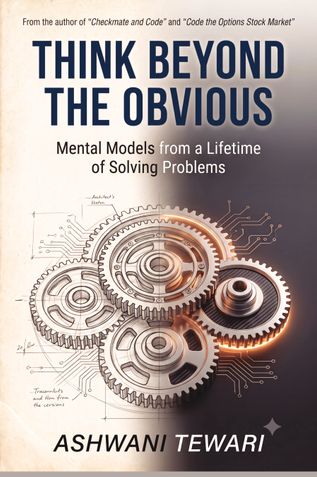
Each chapter begins with a real incident from my professional life. More importantly, each ends with a simple mental model—a specific way of approaching problems that has remained useful long after the technologies themselves became obsolete.
Many of the systems described in these pages do not exist now. Programming languages have evolved, computers have become millions of times faster and artificial intelligence is actively changing the way we work. The main variable, however, has not changed.
People still make decisions. People still solve problems. People still succeed—or fail—because of the way they think.
If one or more of these stories inspire you to be cautious and think before accepting the simplest solution, and to question your assumptions or view a common issue in a new light, then I will have done my job.
Because in my experience, the most valuable lessons are rarely about technology.
They are about learning to think beyond the obvious.
About the Author
Book Details
ISBN: 9789360387105
Number of Pages: 79
Dimensions: 6"x9"
Interior Pages: B&W
Binding:
Paperback (Perfect Binding)
Availability:
In Stock (Print on Demand)
Ratings & Reviews
Think Beyond the Obvious
Review This Book
Write your thoughts about this book.

Currently there are no reviews available for this book.
Be the first one to write a review for the book Think Beyond the Obvious.
Other Books in Business & Economics, Computers & Internet

Farida Bharmal

Tejeswar Hati
Bemnet Girma Sahilu

Professor Doctor Sanjay Rout, Professor Prangyan Paramita Biswal, ...