You can access the distribution details by navigating to My Print Books(POD) > Distribution
Add a Review
Type:
Print Book
Genre: Self-Improvement, Politics & Society
Language: Hindi
Price:
₹547
+ shipping
This book ships within India only.
Description
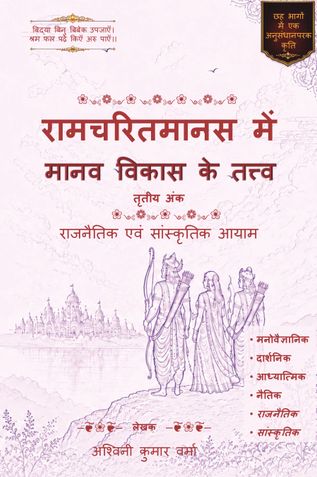
This third volume presents an in-depth and research-oriented study of the political and cultural dimensions embedded in the Ramcharitmanas.
The political dimensions include the role of Devarshi Narada, the intervention of the gods, the status of women, and the wisdom exercised by political advisers. The concept of Ram Rajya is compared with the “real empires” of Ashoka and Marcus Aurelius; Plato’s “Ideal State”; Kant’s “Kingdom of Ends”; the concept of Ram Rajya in Valmiki’s Ramayana; and the Indian constitutional system.
Similarly, the cultural dimensions cover the significance of samskaras (sacraments and rites of passage), the establishment of Rameshwaram, the sanctity of rivers and mountains mentioned in the Ramcharitmanas, the relationship between festivals described in the Manas and those celebrated today, and the objectives of the Ashrama system. They also include a critical examination of the Varna system and the status of women, contributions to society and culture, a research-based essay on the Bhakti Movement, and a biographical account of Tulsidas.
The major topics covered in this volume are:
The Role of Devarshi Narada and Divine Intervention: Their significance in the political and social developments depicted in the Ramcharitmanas.
The Causes of the Downfall of King Bhanupratap and King Bali: An examination of the factors that led to their downfall.
States Founded on Adharma and Dharma: Their respective directions, conditions, and consequences.
A Comparative Study of Ram Rajya: A comparison with the “real empires” of Ashoka and Marcus Aurelius, Plato’s “Ideal State,” Kant’s “Kingdom of Ends,” Ram Rajya as depicted in Valmiki’s Ramayana, and the Indian democratic system.
The Establishment of Rameshwaram and the Promotion of Other Pilgrimage Sites: Their religious, cultural, and historical significance.
The Significance of Rivers and Mountains: The importance of sacred geography, together with the objectives of the Ashrama system and samskaras.
The Varna System and the Status of Women: A critical analysis of controversial verses on these subjects.
The Bhakti Movement: A research-oriented essay examining its historical, social, and cultural significance.
About the Author
Book Details
Number of Pages: 314
Dimensions: 6"x9"
Interior Pages: B&W
Binding:
Paperback (Perfect Binding)
Availability:
In Stock (Print on Demand)
Ratings & Reviews
Elements of Human Development in the Ramcharitmanas, Volume III
Review This Book
Write your thoughts about this book.

Currently there are no reviews available for this book.
Be the first one to write a review for the book Elements of Human Development in the Ramcharitmanas, Volume III.
Other Books in Self-Improvement, Politics & Society

Devesh Gupta

Sanjay Kumar Soni

Bharat Bhushan Pareek Advocate

Lt Col Rohit Agarwal (Retd)