You can access the distribution details by navigating to My Print Books(POD) > Distribution
Add a Review
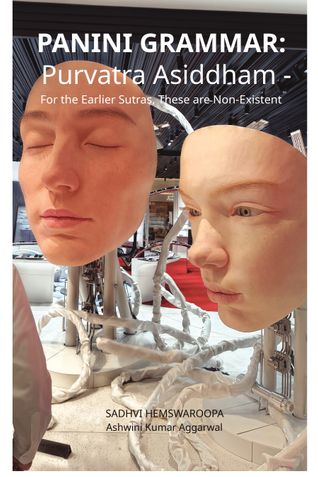
Panini Grammar: Purvatra Asiddham - For the Earlier Sutras, These are Non-Existent
Ashwini Kumar Aggarwal, Sadhvi Hemswaroopa
Type:
Print Book
Genre: Education & Language, Exam Preparation
Language: English, Sanskrit
Price:
₹280
+ shipping
Description
8.2.1 पूर्वत्रासिद्धम्" Pūrvatrāsiddham is a highly critical Adhikāra Sūtra (governing rule) in Panini's Ashtadhyayi. It is located at the very beginning of the eighth chapter's second quarter. In Sanskrit grammar, when two different rules apply at the same time, this rule is used to resolve conflicts and determine the exact operational sequence of the grammatical steps, to arrive at the precise spelling of a word.
Literal Meaning
• Pūrva पूर्व to the earlier part
• Tra त्र the three quarters
• Asiddham (असिद्धम्) are Non-existent / Ineffective / Invisible
The core principle is: Rules that appear later in the order of the Ashtadhyayi (specifically in the final section) are considered "Asiddha" (as if they do not exist) from the perspective of the rules that appeared earlier.
The Structural Division of the Ashtadhyayi
Because of this sūtra, the entire Ashtadhyayi is split into two distinct functional parts:
First Part: From Rule 1.1.1 right up to Rule 8.1.74 sapāda-saptādhyāyī (initial 7¼ Chapters)
Second Part: From Rule 8.2.1 to the very end 8.4.68 tripādī (last 3 Quarters)
How It Works
The Pūrvatrāsiddham rule operates on two distinct levels:
• Sapādasaptādhyāyī vs. Tripādī - When a rule from the first 7¼ chapters is operating, any changes made by a rule from the last 3 quarters Tripādī are completely invisible or non-existent to it. The first part cannot "see" the modifications made by the last part.
• For example, a rule at 8.2.66 is non-existent to a rule at 6.1.113.
• Within the Tripādī itself - Even inside the Tripādī, a rule that comes later (para-shastra) is considered invisible to a rule that comes earlier (purva-shastra).
• For example, a rule at 8.4.58 is non-existent to a rule at 8.3.24.
Practical Purpose
Panini created this rule to prevent grammatical operations from falling into an infinite loop. Without this rule, if a later sūtra alters a letter, that modification might trigger an earlier sūtra to apply all over again, making the word-formation process endless. Pūrvatrāsiddham ensures a one-way progression, once the derivation moves forward into the Tripādī, the earlier rules cannot look back and react to the new changes.
About the Authors
Book Details
ISBN: 9789348012845
Publisher: Devotees of Sri Sri Ravi Shankar Ashram
Number of Pages: 84
Dimensions: 6"x9"
Interior Pages: B&W
Binding:
Paperback (Perfect Binding)
Availability:
In Stock (Print on Demand)
Ratings & Reviews
Panini Grammar: Purvatra Asiddham - For the Earlier Sutras, These are Non-Existent
Review This Book
Write your thoughts about this book.

Currently there are no reviews available for this book.
Be the first one to write a review for the book Panini Grammar: Purvatra Asiddham - For the Earlier Sutras, These are Non-Existent.
Other Books in Education & Language, Exam Preparation

NABAL KISHORE PANDE

Ashwini Kumar Aggarwal, Sadhvi Hemswaroopa
Sujoy Bag

Madan Gopal Goel