You can access the distribution details by navigating to My Print Books(POD) > Distribution
Add a Review
Type:
Print Book
Genre: Business & Economics
Language: English
Price:
₹1,300
+ shipping
Description
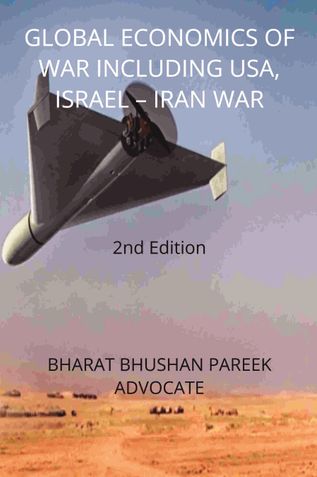
GLOBAL ECONOMICS OF WAR — Including the USA, Israel–Iran War (2nd Edition) is a book built on one question: when a war breaks out, whose interests does it actually serve, and who is left to pay for it?
When the United States and Israel struck Iran in February 2026, defense stocks moved within hours. A stablecoin issuer posted a $10 billion annual profit while paying its 530 million users nothing. A single market-making firm cleared $39.6 billion in a year its own filings partly credited to war-driven volatility. None of this required speculation to uncover — only the patience to read the filings, the contracts, and the sanctions lists that most coverage of war never touches.
This substantially revised second edition traces that question across twenty-five centuries, from the grain embargoes of ancient Athens through the Napoleonic Wars, two world wars, and the Cold War arms race, into the financial instruments that increasingly define conflict today: sanctions regimes, cyber warfare, artificial intelligence, stablecoins, and the institutions — the IMF, the WTO, FATF — nominally built to govern them.
At its center is the new USA, Israel–Iran War, followed here in unusually close, real-time detail: the defense contractors whose stock buybacks continued even as front-line forces faced interceptor shortages; the Beltway consultancies whose federal contracts grew through the same months their own government complained about profiteering; the reconstruction funds pledged in the billions and, months later, still sitting at zero; the drone economics in which a $20,000 weapon can force a $4 million response. Dedicated chapters extend the same method to the Russia-Ukraine war, Afghanistan, Syria, Gaza, Iraq, Libya, and the India-Pakistan water dispute — each examined for the same underlying pattern of concentrated benefit and diffused cost.
This is not an argument against any government's specific decisions, and it does not accuse the individuals or institutions named in these pages of bad faith. Most of what it documents is entirely lawful. Its claim is structural: that the economic incentives running through modern war deserve the same scrutiny normally reserved for its stated strategic or moral justification — and that this accounting is too often left out of the public record simply because it is harder to see than a battlefield map.
Written by a practicing advocate of nearly four decades' standing at the Rajasthan High Court, and built almost entirely on primary sources — regulatory filings, government data, court rulings, and on-the-record reporting rather than opinion — this book is for readers who want to follow a war's money as closely as its politics, and who are willing to let the footnotes, not the headlines, carry the argument.
About the Author
Book Details
ISBN: 9789334466164
Publisher: Self-Published
Number of Pages: 610
Dimensions: 6.00"x9.00"
Interior Pages: B&W
Binding:
Paperback (Perfect Binding)
Availability:
In Stock (Print on Demand)
Ratings & Reviews
Global Economics of War Including USA, Israel – Iran War
Review This Book
Write your thoughts about this book.

Currently there are no reviews available for this book.
Be the first one to write a review for the book Global Economics of War Including USA, Israel – Iran War.
Other Books in Business & Economics

Dharmpal Chaudhary

Subhasis Ghosh

Ashish Mehta

Sanjay Chaudhary