You can access the distribution details by navigating to My Print Books(POD) > Distribution
Add a Review
This book ships within India only.
Description
Every organization has a moment no one names. The strategy is sound. The slides have landed. The leader has spoken with conviction. And the room keeps looking forward, waiting for something the leader cannot supply.
Roughly $366 billion a year now flows into leadership development. Barely one in ten executives believes it works, and only one in five employees worldwide is engaged at work. Fifty years of refinement have gone into answering a question that was only ever half the problem.
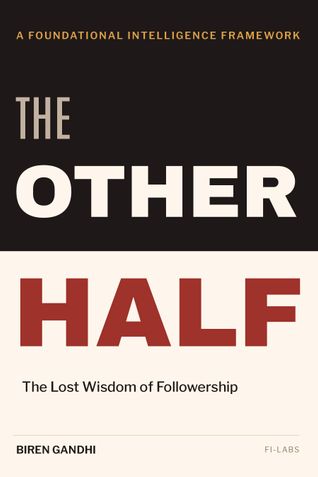
The Other Half makes a case that will change how you read every meeting you sit in: followership is not the absence of leadership. It is a parallel discipline — with its own attributes, its own failure modes, and its own developmental path — and it has been left almost entirely undeveloped while all the attention went to the other side.
It is also not someone else's job. The grid in this book describes moments, not people. You lead when you set the direction; you follow, an hour later, when your CFO tells you what the model will actually support. Most executives have spent a career treating the second kind of moment as an interruption to the real work. It is the work — and almost no one has been trained for it.
Biren Gandhi builds the missing half into a working architecture: twelve attributes across six rows, each pairing a leadership quality with its followership counterpart. The first three rows form an inner compass; the last three are the impact that compass produces in the world — and the sequence cannot be skipped.
The vocabulary is deliberately older than the field it corrects. Each attribute carries a Sanskrit term — viveka, dhriti, nishtha — drawn from a body of thought that was examining discernment, endurance, and fidelity long before any management text existed. The terms are not ornament. Each earns its place by naming something English cannot quite reach, and where one fails that test, the book says so and drops it.
The evidence is concrete and checkable throughout: Indra Nooyi at PepsiCo, Hubert Joly at Best Buy, Paul O'Neill at Alcoa, Cynthia Cooper at WorldCom, Ed Catmull's Braintrust at Pixar, Herb Kelleher's four decades of profit at Southwest — set against Boeing, Wells Fargo, and Challenger, whose collapses return as a quiet drumbeat. No composite cases. No disguised examples.
What you will take away
→ A vocabulary — twelve named attributes that describe organizational capability with a precision today's management language does not allow.
→ A diagnostic — a twelve-point profile you can run on a single page, showing which half of your organization is over-fed and which is quietly starving.
→ A practice — how to build both columns deliberately, and how to wire them into hiring, promotion, team design, and culture.
Written to be used, not just read
Every chapter closes with pointed questions for the coach and the coached, and the appendix gathers all of them into a Coach's Index built for engagements, cohorts, and board offsites.
For CEOs, senior executives, CHROs, and the coaches who work with them — and for anyone who has watched a good strategy die between the all-hands and the work.
The ignored half is ignored no longer.
→ Book Details at: https://birengandhi.com/toh.
About the Author
Book Details
Number of Pages: 280
Dimensions: 6"x9"
Interior Pages: B&W
Binding:
Paperback (Perfect Binding)
Availability:
In Stock (Print on Demand)
Ratings & Reviews
The Other Half: The Lost Wisdom of Followership
Review This Book
Write your thoughts about this book.

Currently there are no reviews available for this book.
Be the first one to write a review for the book The Other Half: The Lost Wisdom of Followership.
Other Books in Business & Economics

Olivia jr

Seyed E.zamani

The ProdMan Club of IIM Ahmedabad