You can access the distribution details by navigating to My Print Books(POD) > Distribution
Add a Review
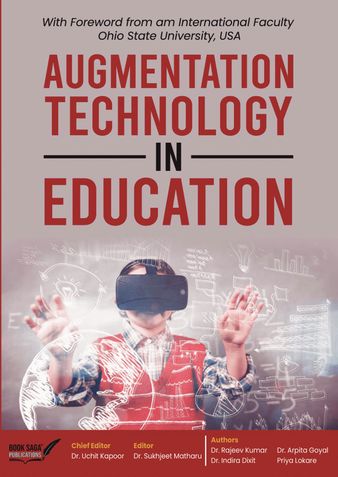
Augmentation Technology in Education
Chief Editor: Dr. Uchit Kapoor, Editor: Dr. Sukhjeet Matharu, Dr. Rajeev Kumar, Dr. Indira Dixit, Dr. Arpita Goyal, Priya Lokare
Description
The rapid advancement of technology has fundamentally transformed the landscape of education, giving rise to the field of Educational Augmentation Technology (EAT). At its core, EAT refers to the application of advanced technologies—such as artificial intelligence (AI), virtual reality (VR), augmented reality (AR), machine learning (ML), and adaptive learning platforms—to enhance teaching methodologies, personalize learning experiences, and bridge gaps in traditional educational systems. Unlike mere digitization or online content delivery, educational augmentation involves the dynamic integration of technology into the learning process to create more immersive, engaging, and efficient educational environments. The need for such augmentation stems from growing challenges in contemporary education, including disparities in access, learning pace variability, cognitive diversity, and evolving skill requirements in the 21st-century job market. Technologies under the umbrella of EAT can adapt content in real time based on a learner’s needs, provide multisensory learning through simulations, and enable continuous assessment and feedback. Moreover, EAT encourages a shift from a teacher-centric to a learner-centric paradigm, fostering autonomy, critical thinking, and creativity among students.
About the Authors
Book Details
ISBN: 9789367267899
Publisher: Book Saga Publications
Number of Pages: 209
Dimensions: 8.27"x11.69"
Interior Pages: B&W
Binding:
Paperback (Perfect Binding)
Availability:
In Stock (Print on Demand)
Ratings & Reviews
Augmentation Technology in Education
Review This Book
Write your thoughts about this book.

Currently there are no reviews available for this book.
Be the first one to write a review for the book Augmentation Technology in Education.
Other Books in Education & Language
Nithyasri s
Smriti Singh, Shalini Agarwal
Neetu G. Bhatia
Dr. Dinachandra Singh Chingakham, Ksh. Manoj Kumar Singha