You can access the distribution details by navigating to My Print Books(POD) > Distribution
Add a Review
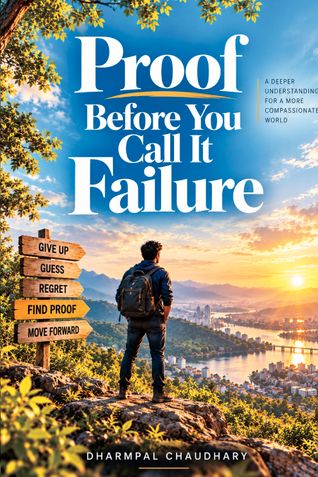
Proof Before You Call It Failure
Difference Between Failure, Setback, and Giving Up Too Soon
Dharmpal ChaudharyType:
Print Book
Genre: Self-Improvement, Business & Economics
Language: English
Price:
₹299
+ shipping
Description
What if what you call failure is actually one of three very different things: a completed experiment, a setback, or simply giving up before you found out?
Proof Before You Call It Failure challenges one of the most repeated ideas in entrepreneurship and life: that failure automatically makes you wiser. The book argues that failure, by itself, teaches very little. What matters is whether you extracted something specific and usable from what happened.
At the heart of the book is a deceptively simple distinction:
Stopping is not the same as running.
You stop when you had a question, tested it, got an answer, and acted on the result. You run when the attempt became difficult, frightening, expensive or humiliating and you left before the underlying question was answered. From the outside, both can look exactly the same. From the inside, they produce completely different lessons.
The book gives you a practical Failure Audit built around five questions:
- What question was this attempt actually supposed to answer?
- Did you answer it?
- What was yours, and what was outside you?
- What specific knowledge or skills transfer to something else?
- Are you changing fields because the evidence requires it—or because you want to escape the experience?
It then identifies four conditions under which failure becomes genuinely useful:
The question was answered.
You took responsibility for your part.
You stayed close enough to the original domain for the lesson to apply.
You used what you learned before the lesson became stale.
The book also examines the other side of the decision: when continuing is more expensive than stopping. Money is only one part of the cost. Time, employee careers, family obligations, debt, relationships and your future ability to attempt something else can all be consumed by continuing something that no longer has a credible path forward.
At the same time, this is not a book about quitting. It identifies situations where stopping may itself be premature—when a cheap test remains untried, the trend could still cross a defined threshold, or a specific and fixable problem has been identified. Persistence with a question and a deadline is different from continuing simply because stopping feels painful.
For entrepreneurs, founders, professionals and anyone who has recently closed something important, the book addresses the parts that come after the decision too: employees, investors, family money, obligations, reputation, what to salvage, how to explain the experience, when to attempt something again, and how to prevent hindsight from rewriting what actually happened.
Most importantly, it asks you to separate the story from the evidence.
A negative result is still a result.
Stopping is not automatically failure.
Pain is not proof that you learned something.
And continuing is not automatically courage.
The question underneath the entire book is:
“Can I state, in one sentence, what I now know that I did not know before?”
About the Author
Book Details
ISBN: 9788118168034
Publisher: Janteera
Number of Pages: 107
Dimensions: 6.00"x9.00"
Interior Pages: B&W
Binding:
Paperback (Perfect Binding)
Availability:
In Stock (Print on Demand)
Ratings & Reviews
Proof Before You Call It Failure
Review This Book
Write your thoughts about this book.

Currently there are no reviews available for this book.
Be the first one to write a review for the book Proof Before You Call It Failure.
Other Books in Self-Improvement, Business & Economics

Md Tafeel Sadat Khan
Krishna Chauhan

SARDAR PARAMJIT SINGH