You can access the distribution details by navigating to My Print Books(POD) > Distribution
Add a Review
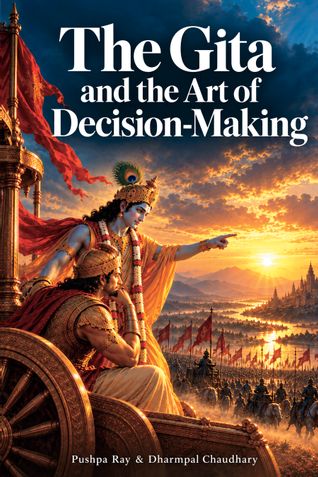
The Gita and the Art of Decision-Making
What the Gita Teaches Us About Making Better Decisions
Dharmpal Chaudhary, Pushpa RayType:
Print Book
Genre: Religion & Spirituality
Language: English
Price:
₹299
+ shipping
Description
What if the Bhagavad Gita is not only a spiritual text, but also one of the oldest and most sophisticated texts about decision paralysis?
On the battlefield of Kurukshetra, Arjuna faces an impossible choice. He knows the consequences of both action and inaction, has serious reasons on both sides, and yet cannot move. Krishna does not simply tell him to “be strong.” He takes him through an extended argument that ultimately returns the decision to Arjuna himself.
The Gita and the Art of Decision-Making examines that conversation as a practical framework for making difficult decisions in modern life.
The book extracts six moves from the Gita's argument:
1. Name the collapse — understand what is happening to you before analysing the decision.
2. Establish what is actually yours — separate your genuine responsibilities from other people's expectations and outcomes.
3. Separate the act from the result — focus on the action you can control without demanding a guaranteed outcome.
4. Recognise that inaction is also a choice — understand the consequences of continuing not to decide.
5. Build steadiness, not indifference — care about the outcome without allowing it to destabilise your judgment.
6. Decide for yourself — after hearing the argument, the responsibility for the decision ultimately remains yours.
The book applies this framework to career decisions, family obligations, conflicting duties, uncertainty, relationships, and the difficult choices that arise when what you want conflicts with what others expect from you. It pays particular attention to the realities of Indian family and professional life, where decisions can involve parents, siblings, financial responsibilities, social expectations, and inherited obligations.
But this is not a devotional retelling or a conventional appreciation of the Gita. The authors deliberately separate the practical decision-making framework from the text's metaphysical claims, examine difficult arguments within the Gita, and engage with critical perspectives including those associated with B. R. Ambedkar. The book explicitly acknowledges where its interpretation may be weak and encourages readers to examine the original text and competing interpretations themselves.
At its heart, the book asks two questions:
What is actually mine to do? And what am I demanding before I am willing to do it?
A practical companion for anyone facing a difficult decision—and for anyone willing to read one of India's foundational texts critically rather than simply accepting or rejecting it.
About the Authors
Book Details
ISBN: 9788118168003
Publisher: Janteera
Number of Pages: 85
Dimensions: 6.00"x9.00"
Interior Pages: B&W
Binding:
Paperback (Perfect Binding)
Availability:
In Stock (Print on Demand)
Ratings & Reviews
The Gita and the Art of Decision-Making
Review This Book
Write your thoughts about this book.

Currently there are no reviews available for this book.
Be the first one to write a review for the book The Gita and the Art of Decision-Making.
Other Books in Religion & Spirituality

Dr. Venkat Potana

Vivek Sharma

Vidyatma Teerth

Ashwini Kumar Aggarwal