You can access the distribution details by navigating to My Print Books(POD) > Distribution
Add a Review
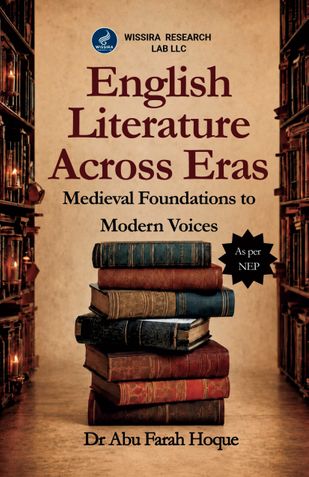
Description
English literature represents a continually evolving conversation between language, history, imagination, and human experience. From the heroic narratives preserved by early communities to the diverse voices circulating through contemporary print and digital cultures, literary expression has reflected-and frequently challenged-the societies from which it emerged.
English Literature Across Eras: Medieval Foundations to Modern Voices has been developed to provide readers with a chronological yet interpretive journey through major periods of English literary history. Rather than treating literary movements as isolated categories, the book examines relationships among texts, historical events, intellectual transformations, social structures, and changing cultural values.
The journey begins with Old and Middle English traditions, where oral storytelling, religious expression, heroic narratives, and vernacular writing established foundations for later literary development. It then moves into the Renaissance, examining humanism, poetry, theatre, and the remarkable expansion of dramatic literature. Seventeenth-century writing demonstrates the powerful interaction among literature, religion, philosophy, and political conflict.
The Restoration and Augustan periods reveal literature's growing engagement with reason, satire, public debate, and print culture. Romanticism subsequently redirects attention toward imagination, emotion, nature, freedom, and individual experience. Victorian literature broadens this engagement by confronting industrialization, class inequality, scientific development, morality, gender expectations, and imperial culture.
The twentieth century produced equally significant transformations. Modernist writers challenged conventional narrative structures as they sought forms capable of representing fragmented consciousness and rapidly changing societies. Postwar and postcolonial authors reconsidered empire, national identity, migration, memory, language, and cultural authority. Contemporary literature extends these conversations into an increasingly interconnected world shaped by globalization, environmental concerns, technological development, and diverse forms of identity.
Throughout the book, representative authors and texts are considered not simply because of their canonical status but because they demonstrate important transformations in literary language, form, ideas, and cultural representation. Examples and contextual discussions encourage readers to connect individual works with wider historical developments.
This book is intended for students, teachers, researchers, and general readers seeking an accessible but academically grounded introduction to English literary history. Its central purpose is to demonstrate that literature is neither static nor confined to the past. Every literary era inherits traditions, questions them, transforms them, and passes altered forms to subsequent generations.
About the Author
Book Details
ISBN: 9789375590538
Publisher: WISSIRA RESEARCH LAB
Number of Pages: 131
Dimensions: 5.5"x8.5"
Interior Pages: B&W
Binding:
Paperback (Perfect Binding)
Availability:
In Stock (Print on Demand)
Ratings & Reviews
English Literature Across Eras: Medieval Foundations to Modern Voices
Review This Book
Write your thoughts about this book.

Currently there are no reviews available for this book.
Be the first one to write a review for the book English Literature Across Eras: Medieval Foundations to Modern Voices.
Other Books in Literature & Fiction
आदर्श आनंद
ADVAITA PAL
Seyed E.Zamani
Abhik Dutta