You can access the distribution details by navigating to My Print Books(POD) > Distribution
Add a Review
Type:
Print Book
Genre: Social Science, Politics & Society
Language: English
Price:
₹650
+ shipping
This book ships within India only.
Description
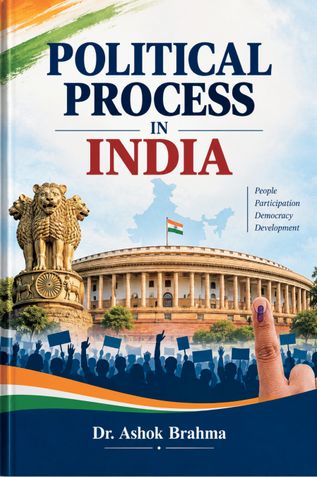
Indian democracy is a dynamic political system shaped by constitutional principles, democratic institutions, federal relations, electoral processes, and the diverse social identities of its people. Since the adoption of the Constitution of India, the country has witnessed significant political, institutional, and socio-economic transformations. Understanding these developments requires a comprehensive study of constitutional institutions, Centre-State relations, political processes, and identity politics. This book aims to provide students, teachers, researchers, and competitive examination candidates with a systematic understanding of Indian politics and its contemporary challenges.
The book is organised into four major parts. Part I: Institutional Functioning: Jurisdiction and Overreach examines the structure, powers, functions, and responsibilities of the Legislature, Executive, and Judiciary. It discusses Parliament, the Rajya Sabha, the Lok Sabha, parliamentary procedures, committees, legislative reforms, and debates on parliamentary decline. It also analyses the roles of the President, Vice-President, Prime Minister, Council of Ministers, Governors, and Chief Ministers. The judicial system is explored through judicial review, judicial activism, judicial independence, Public Interest Litigation, judicial accountability, and judicial reforms, with particular attention to institutional jurisdiction and constitutional accountability.
Part II: Indian Federalism: Emerging Trends and Issues focuses on the constitutional foundations of Indian federalism and the distribution of legislative, administrative, and financial powers between the Union and the States. It examines Centre-State relations, political economy, centralisation, and regional autonomy. The discussion also covers democratic decentralisation through Panchayati Raj Institutions, Gram Sabhas, and urban local bodies. Contemporary debates, including One Nation, One Policy and One Nation, One Election, are considered in relation to constitutional principles, democratic representation, and the balance of federal powers.
Part III: Political Process explores the functioning of political parties, the party system, national and regional parties, electoral alliances, and the democratic process. It examines the role of the Election Commission of India, the electoral system, electoral finance, the criminalisation of politics, electoral ethics, Electronic Voting Machines (EVMs), Voter Verifiable Paper Audit Trail (VVPAT), and voting behaviour. These topics highlight the importance of free and fair elections, political participation, transparency, accountability, and democratic representation.
Part IV: Issues and Identity Politics analyses the influence of caste, class, ethnicity, and religion on Indian politics. It examines Indian secularism, social justice, political mobilisation, and demands for representation and autonomy. Special attention is given to autonomy movements in North-East India, including insurgency movements and demands for separate statehood. These discussions help readers understand regional aspirations, indigenous peoples' rights, ethnic diversity, and the challenges of maintaining peace, political stability, and national integration within a democratic framework.
The central objective of this book is to connect constitutional provisions and institutional structures with the practical functioning of Indian democracy. It emphasises that democratic governance depends not only on constitutional arrangements but also on institutional accountability, political leadership, citizen participation, and respect for democratic values. Similarly, federalism involves a continuous process of cooperation, negotiation, and adjustment between different levels of government, while electoral democracy requires transparency, fairness, and informed public participation.
The book is intended as an academic resource for undergraduate and postgraduate students of Political Science, teachers, researchers, and candidates preparing for competitive examinations. The topics have been arranged systematically to support classroom teaching, independent learning, and critical analysis of contemporary political developments.
About the Author
Book Details
ISBN: 9789360686482
Publisher: Dr. Ashok Brahma
Number of Pages: 439
Dimensions: 6.00"x9.00"
Interior Pages: B&W
Binding:
Paperback (Perfect Binding)
Availability:
In Stock (Print on Demand)
Ratings & Reviews
Political Process in India
Review This Book
Write your thoughts about this book.

Currently there are no reviews available for this book.
Be the first one to write a review for the book Political Process in India.
Other Books in Social Science, Politics & Society

Rajiv Agarwal

Christophe J. A. Ranque

Dr. Denis Archer
Subrahmanya R.K.A.