You can access the distribution details by navigating to My Print Books(POD) > Distribution
Add a Review
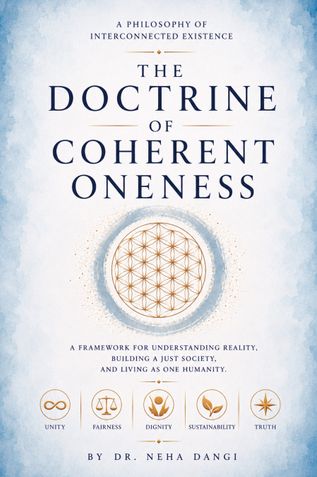
Description
Human civilization has developed across multiple domains, philosophy, eco- nomics, governance, and culture. Each domain has produced frameworks that attempt to explain reality, guide behavior, or organize society. However, these frameworks are often fragmented. They address isolated aspects of human life without integrating them into a coherent whole.
As a result, modern systems frequently operate with internal contradictions. Economic systems prioritize productivity while generating inequality.
Social systems emphasize identity while producing division. Political systems pursue order while facing instability.
Individuals seek meaning while navigating conflicting values.
These tensions are not accidental. They arise from a deeper issue: the absence of a unified structure that connects how reality is understood, how humans behave, and how systems are organized.
The Doctrine of Coherent Oneness is proposed as a response to this condi- tion.
Its starting point is a structural observation: human systems are not composed of isolated elements but of interconnected relationships. Actions taken in one domain produce consequences in others. Decisions made at the individual level influence collective systems, and systemic conditions shape individual behavior.
Despite this interconnected nature, most frameworks continue to operate as if separation were fundamental. This leads to decisions that may appear effective in isolation but produce instability when viewed systemically.
The doctrine therefore establishes a different foundation.
It does not begin with ideology, identity, or tradition. It begins with
DOCTRINE OF COHERENT ONENESS
structure:
• Reality is interconnected
• Knowledge must align with reality
• Human behavior is shaped by both agency and constraint
• Ethical systems must preserve equality of worth and dignity
• Justice must integrate merit, context, and ethical limits
• Systems must balance incentive, stability, and accountability
From these principles, the doctrine develops a unified framework that con- nects understanding, behavior, and organization.
This framework is not presented as a belief system. It does not require adherence based on authority or tradition. Instead, it offers a structured method for evaluating reality and organizing human systems.
The purpose of the doctrine is threefold:
1. To provide conceptual clarity
2. It organizes complex ideas into a coherent structure, reducing fragmen- tation across domains.
3. To guide decision-making
4. It translates principles into evaluative criteria that can be applied in practical contexts.
5. To support systemic stability
6. It aligns human systems with the structural conditions of interconnected existence.
The doctrine does not claim to eliminate conflict or complexity. Such conditions are inherent to human systems. Instead, it provides a framework for navigating them in a consistent and rational manner.
It is also not a fixed or final system. As knowledge evolves and conditions change, the application of the doctrine must adapt. However, its foundational principles remain stable.
The Doctrine of Coherent Oneness is therefore best understood as a framework for alignment, alignment between reality, understanding, behavior, and system design.
About the Author
Book Details
Number of Pages: 180
Dimensions: 6.00"x9.00"
Interior Pages: B&W
Binding:
Paperback (Perfect Binding)
Availability:
In Stock (Print on Demand)
Ratings & Reviews
Doctrine of Coherent Oneness
Review This Book
Write your thoughts about this book.

Currently there are no reviews available for this book.
Be the first one to write a review for the book Doctrine of Coherent Oneness.