You can access the distribution details by navigating to My Print Books(POD) > Distribution
Add a Review
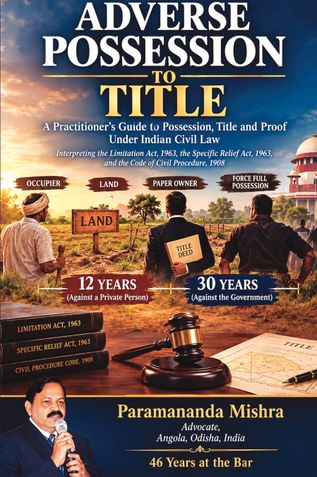
ADVERSE POSSESSION TO TITLE
A Practitioner's Guide to Possession, Title and Proof Under Indian Civil Law
Dr. Paramananda Mishra
This book ships within India only.
Description
The doctrine of adverse possession rests on an old and unsentimental maxim: vigilantibus non dormientibus jura subveniunt — the law helps the vigilant, not those who sleep on their rights. It is not a doctrine that rewards wrongdoing so much as one that refuses, after a fixed period of inaction, to keep reopening a settled state of affairs.
In my forty-six years of practice at the Bar in Odisha, I have seen this area of law misunderstood by claimants and paper owners alike. Claimants often believe that mere long occupation, without more, is enough. Paper owners often believe that a registered sale deed, or a Record of Rights entry in their name, is by itself a permanent shield against every subsequent occupant. Neither belief survives contact with the statute books or with the developing jurisprudence of the Supreme Court and of our own High Court of Orissa.
This book grew out of a straightforward professional need: a single, dependable reference that brings together the three statutes that actually govern these disputes — the Limitation Act, 1963, the Specific Relief Act, 1963, and the Code of Civil Procedure, 1908 — and shows, through pleadings, cross-examination, and argument, how they operate together in a live court file rather than as three separate subjects in three separate books. Because a considerable part of my own practice has involved land held by, or claimed against, the State, this book also gives particular attention to the thirty-year period under Article 112 and to the special considerations that arise when the true owner is the Government rather than a private party — a dimension many general treatises pass over quickly, but which our High Court's docket makes impossible to ignore.
The most significant development in this area in recent years is the Supreme Court's three-judge bench decision in Ravinder Kaur Grewal v. Manjit Kaur, (2019) 8 SCC 729, which settled a long-running controversy by holding that a person who has perfected title by adverse possession may sue to establish and recover that title, and is not confined to raising adverse possession defensively. That decision reshapes how this book had to be written, and it is discussed at length in Chapter Two.
This is a practitioner's book, not an academic treatise. Its aim is to help a lawyer prepare a plaint, resist one, examine a witness, or argue a final hearing, with the statutory scheme and the leading authorities close at hand.
About the Author
Book Details
Number of Pages: 102
Dimensions: 6"x9"
Interior Pages: B&W
Binding:
Paperback (Perfect Binding)
Availability:
In Stock (Print on Demand)
Ratings & Reviews
ADVERSE POSSESSION TO TITLE
Review This Book
Write your thoughts about this book.

Currently there are no reviews available for this book.
Be the first one to write a review for the book ADVERSE POSSESSION TO TITLE.
Other Books in Law

प्रदीप कुमार राय ( Pradip Kumar Ray )

Siva Prasad Bose, Joy Bose

Hemant K. Batra

Dr. Suketu V. Shah